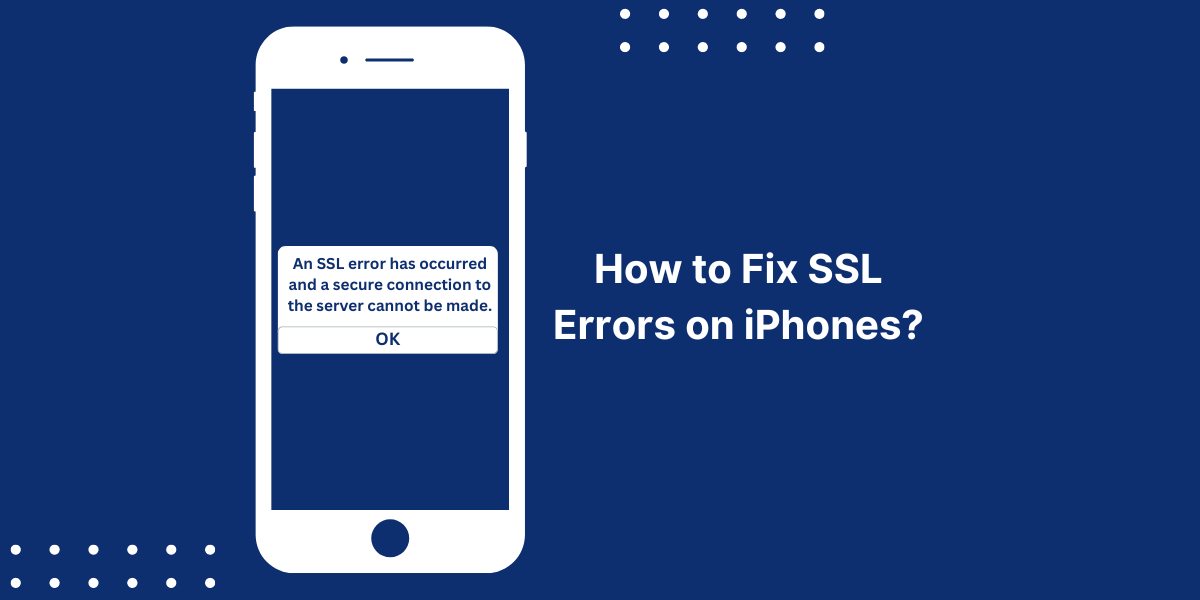
SSL errors on iPhone appear when Safari or another app cannot verify a website's security certificate. The most common cause is an incorrect date and time setting on your device - iOS uses this to validate certificate expiry. Other triggers include outdated iOS versions, corrupt cached data, VPN interference, or a genuinely misconfigured server. This guide covers 9 tested fixes for iOS 16, 17, and 18, starting with the quickest ones.
What is an SSL error on iPhone? An SSL error on iPhone is a security warning that appears when iOS cannot verify that a website's certificate is valid, trusted, or current. It means the encrypted connection between your device and the server failed to establish. In practice, this blocks the page from loading and displays a warning in Safari or whichever app made the request.
What Causes SSL Errors on an iPhone?
An SSL error on iPhone means iOS could not complete a secure handshake with the server. This happens when the certificate is expired, untrusted, or when device settings prevent proper validation.
The three most frequent causes are:
- Wrong date/time on device - the most overlooked and fastest fix
- Expired or self-signed server certificate - a server-side problem
- VPN or firewall intercepting the SSL connection - common on work or school networks
For specific error codes, solutions include clearing cookies and cache, resetting network settings, or contacting your ISP or the website owner.
9 Working Solutions: Quick Reference
Try these fixes in order. Most users resolve the issue within the first three steps.
| # | Fix | Works Best For | Time |
| 1 | Fix date and time | Most SSL errors instantly | 30 sec |
| 2 | Update iOS | Certificate trust store issues | 5–15 min |
| 3 | Clear Safari cache | Corrupt cached certificate data | 1 min |
| 4 | Disable VPN | SSL error on WiFi only | 30 sec |
| 5 | Trust certificate manually | Enterprise / self-signed cert | 2 min |
| 6 | Forget & rejoin WiFi | Network-level SSL interception | 1 min |
| 7 | Reset network settings | Persistent network-related errors | 2 min |
| 8 | Try Chrome on iOS | Safari-specific SSL failures | 2 min |
| 9 | Contact website owner | Server certificate expired | Varies |
Each fix is explained with step-by-step instructions below.
Fix 1: Correct Your iPhone's Date and Time
Set your device to update time automatically - this single step resolves the majority of SSL errors. iOS uses the current date to check whether a certificate is within its valid period.
What most people get wrong: they assume SSL errors are always caused by the website. Over half of iPhone SSL errors in non-enterprise settings trace back to the device clock being even a few minutes off - especially after travel across time zones or after a device battery drain.
Follow these steps:
- Open Settings → General → Date & Time
- Enable Set Automatically
- Restart Safari and reload the page
If the error disappears, the certificate's date validation was failing. This fix works across iOS 16, 17, and 18 - and takes 30 seconds.
Fix 2: Update iOS to the Latest Version
Apple ships certificate trust store updates inside iOS releases. An older iOS version may not recognize newer root certificate authorities, causing Safari to reject valid certificates.
To update:
- Go to Settings → General → Software Update
- Download and install any available update
- Recheck the website after the device restarts
As of January 2026, iOS 18.7.4 is the latest stable release. Running iOS 16 or below increases the chance of encountering certificate trust errors on newer websites.
Fix 3: Clear Safari Cache and Website Data
Corrupt cached certificate data can cause Safari to block a valid site. Clearing it forces Safari to re-fetch and re-validate the certificate from scratch.
Steps:
- Go to Settings → Safari
- Tap Clear History and Website Data
- Confirm → reopen Safari and reload the page
This fix works when the SSL error appears on a site that was previously accessible. Safari occasionally stores a stale or mismatched certificate state that survives across sessions - clearing it resets that entirely.
Fix 4: Disable VPN or Proxy
If the SSL error appears on WiFi but not on mobile data, a VPN or proxy is intercepting the connection. iOS cannot complete certificate validation when a VPN re-signs traffic with its own certificate.
To disable VPN: go to Settings → VPN → toggle off Active VPN, or open the VPN app and disconnect manually. Reconnect to WiFi and test the site again.
Currently, this is especially common on corporate or school networks that run SSL inspection tools. According to Apple's proxy and VPN configuration guide (2024), SSL inspection causes certificate mismatch errors on iOS when the proxy certificate is not installed as a trusted root.
Fix 5: How Do You Trust a Certificate on iPhone Manually?
To trust a certificate on iPhone, go to Settings → General → About → Certificate Trust Settings and enable full trust for the certificate. This applies to enterprise or developer-issued certificates that are not in Apple's default trust store.
Steps for iOS 16, 17, and 18:
- Install the certificate profile (usually sent via email or MDM)
- Go to Settings → General → VPN & Device Management
- Tap the certificate profile and install it
- Then go to Settings → General → About → Certificate Trust Settings
- Toggle on full trust for the certificate
Note for iOS 18 users: a known bug affects devices that upgraded directly from iOS 16 to iOS 18 - certificates may not appear in the Trust Settings list. According to Apple's iOS 18 certificate trust documentation (updated 2025), the fix is to reinstall the certificate profile via Settings → General → VPN & Device Management.
Never manually trust a certificate from an unknown or unverified source - doing so exposes your device to potential SSL interception attacks.
Fix 6: Forget and Rejoin the WiFi Network
When an SSL error appears only on one specific WiFi network, forgetting and rejoining it forces a fresh connection - clearing any cached DNS entries or DHCP misconfigurations that may be blocking certificate validation.
Steps:
- Go to Settings → WiFi
- Tap the (i) icon next to the network name
- Tap Forget This Network → confirm
- Reconnect by selecting the network and entering the password
- Reload the page in Safari
Fix 7: Reset Network Settings
Reset network settings clears all WiFi passwords, VPN configurations, DNS overrides, and cellular settings. Use this fix when the SSL error persists across multiple networks or after Fix 6 fails.
Steps:
- Go to Settings → General → Transfer or Reset iPhone
- Tap Reset → Reset Network Settings
- Enter your passcode and confirm
- Reconnect to WiFi - all saved passwords must be re-entered
This fix does not erase personal data. However, all saved WiFi networks, Bluetooth pairings, and VPN profiles will be removed.
Fix 8: Try Chrome on iOS Instead of Safari
Safari and Chrome on iOS use the same system trust store, but their SSL state caches are independent. If an error appears in Safari but not in Chrome on the same network, the issue is Safari-specific - not the server or your device.
Open Chrome on your iPhone and navigate to the same URL. If the page loads without error, return to Safari and clear its cache via Settings → Safari → Clear History and Website Data. This forces Safari to rebuild its SSL state from scratch.
If the error appears in both browsers, the problem is at the server level or network level - proceed to Fix 9.
Fix 9: Contact the Website Owner
If all 8 fixes above pass and the SSL error appears only on one specific site, the server's certificate is expired, revoked, or misconfigured. No action on your device will resolve a server-side certificate failure.
To confirm it is a server issue: tap the lock icon in Safari address bar → tap Show Certificate → check the Expires field. If the date has passed, the certificate is expired.
As of March 15, 2026, the CA/Browser Forum reduced the maximum SSL certificate lifespan from 398 days to 200 days, according to CA/B Forum ballot summary (April 2025). Sites that renew certificates manually - rather than through automation - face a higher risk of expiry-triggered SSL errors in 2026.
Why Does My iPhone Show an SSL Error Only on WiFi?
When SSL errors appear on WiFi but not on mobile data, the network itself is blocking or intercepting the secure connection - not your device or the website.
Three specific scenarios and their fixes:
- Hotel or airport captive portal: The login page intercepts HTTPS before authentication - connect to the portal page first, then retry the site
- Corporate SSL inspection proxy: The network re-signs traffic using its own certificate - ask your IT team to push the proxy CA certificate to your device via MDM
- Home router DNS issue: Some routers misroute HTTPS traffic - switch DNS to 8.8.8.8 under Settings → WiFi → (i) → Configure DNS → Manual
Safari vs Chrome: Do SSL Errors Differ on iPhone?
Safari and Chrome on iOS both use Apple's WKWebView engine for rendering, but they handle certificate trust differently.
| Factor | Safari | Chrome on iOS |
| Certificate trust store | Uses iOS system trust store | Also uses iOS system trust store |
| Custom CA certificates | Honors profiles installed via Settings | Honors same profiles |
| SSL inspection bypass | Can bypass via Safari Extensions | No extension support on iOS |
| Error message detail | Shows certificate details on tap | Less detail, fewer override options |
If an error shows in Safari but not Chrome, the issue is Safari-specific - often a cached SSL state. Use these steps to clear SSL state on iPhone to reset it.
Taking the Right Next Step
Most SSL errors on iPhone resolve by correcting the device's date and time or updating iOS - both take under two minutes. If the error persists on a specific network, the problem is almost always a VPN or SSL inspection tool intercepting traffic.
For errors tied to a single website, tap the lock icon in Safari to view the certificate details and check the expiry date. If the certificate is expired, only the website owner can fix it.
Looking ahead: As of March 15, 2026, the maximum SSL certificate lifespan dropped from 398 days to 200 days under the CA/Browser Forum's new rules. Sites that do not automate renewals will expire more frequently - expect SSL errors on iPhone to become more common in 2026 as the industry transitions to shorter-lived certificates.
Frequently Asked Questions about SSL Errors on iPhone
Why does my iPhone say 'this connection is not private'?
Safari displays 'This connection is not private' when it cannot verify the website's SSL certificate. The most common causes are an expired certificate on the server, a wrong date/time on your device, or a VPN intercepting the connection. Fixing the date/time setting or disabling the VPN resolves most cases.
Is it safe to ignore an SSL error on iPhone?
No - SSL errors indicate that Safari cannot confirm the website's identity or that the connection may be intercepted. Proceeding exposes your data to potential third-party access. Only bypass the error if you are on a known private network and are certain the certificate is legitimate (for example, a local development server).
How do I fix an SSL error on iPhone email apps?
Go to Settings → Mail → Accounts → select the account → tap the email address → Advanced. Ensure 'Use SSL' is toggled on and the port matches your mail server's SSL settings (993 for IMAP, 465 or 587 for SMTP). Incorrect ports are the top cause of SSL errors in iPhone mail apps.
Why does the SSL error appear after an iOS update?
Some iOS updates change the system date or reset network settings, which can immediately trigger SSL validation failures. Check Settings → General → Date & Time after any update and confirm 'Set Automatically' is still enabled. If you installed a new iOS version, some older certificates may also be newly rejected under tightened trust policies.
Can a bad SSL certificate affect all apps on my iPhone?
Yes - any app that makes HTTPS requests will fail if the server's certificate is invalid or untrusted. SSL errors are not limited to Safari. Apps that rely on background network calls may fail silently or show generic connection errors rather than a specific SSL message.
What is the difference between an SSL error on iPhone and 'Your connection is not private'?
Both refer to the same underlying issue - a failed certificate validation - but the error message depends on the browser or app. Safari typically shows 'This connection is not private', while Chrome displays 'Your connection is not private'. The fixes are identical regardless of which message appears.

Priya Mervana
 Verified Web Security Experts

Priya Mervana is working at SSLInsights.com as a web security expert with over 10 years of experience writing about encryption, SSL certificates, and online privacy. She aims to make complex security topics easily understandable for everyday internet users.