Domain Validated SSL Certificate
A DV SSL Certificate (Domain Validated SSL) confirms domain ownership only, without checking business identity. A Certificate Authority issues it in minutes through an automated challenge, such as a DNS record or an email confirmation. DV SSL suits blogs, portfolios, and internal tools where encryption matters more than visible business identity. Skip it for checkout pages or login forms that handle payment data, where an OV SSL certificate or EV SSL certificate adds a stronger trust signal. Buy a DV certificate when the priority is fast, low-cost encryption for a single domain.
Definition of DV SSL
A DV SSL Certificate encrypts traffic between a browser and a server after confirming that the applicant controls the domain - nothing more. It skips checks on company name, address, or legal status. Encryption strength matches OV and EV certificates; only the identity-verification step differs.
What is Domain Validation?
Domain Validation is the lightest verification tier in the SSL certificate hierarchy. A Certificate Authority checks one fact: does the applicant control the domain named in the certificate? It does this through a Certificate Signing Request, which contains the applicant's public key and domain details, generated using a tool such as SSLInsights' CSR Generator.
Once validated, the CA signs the certificate using its private key, creating a chain of trust back to a root certificate already embedded in every major browser. The result is standard 256-bit TLS encryption - the same cryptographic strength used across every SSL certificate type, regardless of validation level.
DV certificates rely on Public Key Infrastructure, the same trust framework behind OV and EV certificates. The certificate binds a public key to a domain name; the private key stays on the server and never travels over the network. This structure is why HTTPS protects data even on a network an attacker fully controls, such as public WiFi.
The naming can confuse buyers browsing certificate listings. Terms like Domain Validation SSL, Basic SSL Certificate, and Standard DV SSL all describe the same product - a Single Domain DV SSL covering one hostname, issued after automated domain checks. Providers market the same underlying certificate under different labels, so the validation level, not the marketing name, is what determines what the certificate actually proves.
How Does Domain Validation Work?
A DV certificate goes through automated Domain Control Validation before issuance. The applicant proves domain control using one of a few approved methods, then the CA issues the certificate without human review of the business behind it.
- DNS record validation - the applicant adds a CA-specified TXT record to the domain's DNS zone; the CA queries it and confirms a match.
- HTTP file validation - the applicant uploads a token file to a specified path on the web server; the CA fetches it over HTTP.
- Email validation - the CA sends a confirmation link to an admin address listed in WHOIS or a standard address such as admin@domain.com.
Each method proves control, not identity. First, the applicant submits a CSR. Then automated systems check the DNS, file, or email response. Finally, the CA issues the certificate, often within minutes.
Before any of these checks run, the CA also queries the domain's CAA (Certification Authority Authorization) DNS record. A CAA record tells CAs which providers are allowed to issue certificates for that domain; if it lists a different CA, or blocks issuance entirely, the request fails before DCV even begins. Most domains never set a CAA record, which defaults to allowing any public CA to issue - a minor gap that CAA configuration can close.
The CA/Browser Forum's Baseline Requirements govern every validation method a CA can use, and the rules changed for 2026: DNSSEC validation back to the IANA root became mandatory for domain checks, according to the CA/Browser Forum's Baseline Requirements (effective March 2026), while maximum certificate validity dropped from 398 days to 200 days the same month. Expect shorter renewal cycles going forward, regardless of which CA issues the certificate.
Practitioner's Note:
When I audit client DNS zones before recommending DV, I check for stale CAA records first. A misconfigured CAA record blocks even a correctly completed validation challenge, and it's the most common issuance failure I see.
- SSLInsights Team
What Are the Benefits of a DV SSL Certificate?
DV certificates solve the core problem - unencrypted traffic - at minimal cost and effort. Three benefits stand out for most site owners.
- Speed. Issuance completes in minutes, not days, since no reviewer checks business paperwork.
- Cost. Many Certificate Authorities, including Let's Encrypt, issue DV certificates free of charge, while paid single-domain DV SSL options start under $10 a year.
- Automation-friendly. ACME clients such as Certbot renew DV certificates without manual work, which matters for server fleets with many domains.
Let's Encrypt alone was issuing roughly 10 million certificates a day by late 2025, according to Let's Encrypt's 10-year retrospective - nearly all of them domain validated. That volume shows how far automated DV has replaced manual paperwork as the default path to HTTPS.
At SSLInsights, our SSL Checker Tool flags certificates issued through automated DV so administrators can confirm validation type at a glance, alongside expiry and chain integrity.
Cost and speed compound for teams managing many domains. A single manual OV application can take one to three business days per domain; the same team can automate DV issuance for hundreds of domains through a script, with no per-domain waiting period. That difference is why hosting platforms and CDNs default new customer domains to DV rather than requiring an identity review before the first page even loads over HTTPS.
Did You Know?
A domain doesn't need a dedicated IT team to run DV SSL. Anyone who can edit DNS records or upload a file to a web root can complete validation without contacting the Certificate Authority directly.
What Are the Limitations of a DV SSL Certificate?
DV certificates trade identity assurance for speed. Because the CA never checks who runs the business, visitors get no confirmation that a domain belongs to a specific legal entity.
This gap matters most for sites handling payments or sensitive personal data. An attacker can register a lookalike domain and obtain a valid DV certificate for it just as quickly as the legitimate owner can - the padlock icon confirms encryption, not trustworthiness. For that reason, e-commerce platforms and financial services typically choose an OV SSL certificate or EV SSL certificate instead, since both verify the organization behind the domain.
DV also covers only what's listed on the certificate. A Single Domain DV SSL secures one hostname; subdomains need a Multi-Domain SSL or Wildcard SSL certificate instead. Renewal frequency adds a second limitation: shorter validity periods mean DV certificates need automated renewal tooling, or renewal becomes a recurring manual task.
Research Highlight:
Certificate Authority market share shifted quickly in 2026 - ISRG (Let's Encrypt) issued 54.4% of public SSL/TLS certificates in Q1 2026, down from 63.0% the prior quarter, according to Cloudflare Radar certificate transparency data reported by TechnologyChecker.io (April 2026). The drop reflects growing competition from Google Trust Services and Sectigo/ZeroSSL, not a decline in DV issuance overall.
How Does DV SSL Handle Browser Trust?
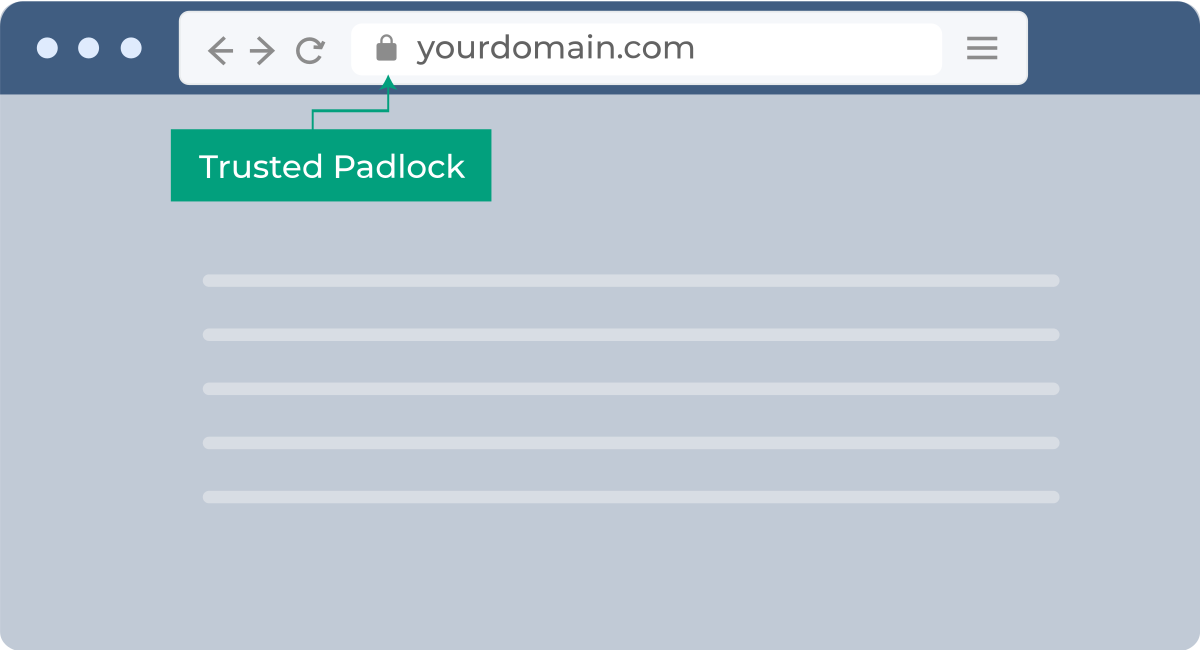
Browsers treat a validated DV certificate the same as OV or EV for encryption purposes. Chrome, Firefox, Safari, and Edge display the padlock icon once the TLS handshake completes, regardless of validation level.
What differs is what happens when validation fails or the chain breaks. An expired, revoked, or mismatched DV certificate triggers the same full-page warning as any other certificate type - browsers don't distinguish validation tiers in their error messaging. Because browsers stopped showing a distinct green address-bar indicator for EV certificates years ago, the visible trust gap between DV and higher validation tiers has narrowed to almost nothing for the average visitor.
This shift changed how site owners think about trust signals. Instead of relying on the browser chrome to communicate business identity, many sites now display separate trust badges, customer reviews, or company information directly on the page. The certificate still does its core job - encrypting the session - while the rest of the trust-building work happens through content the CA never verifies.
When Should You Use a DV SSL Certificate?
A DV SSL certificate for small business use fits several common scenarios where speed and cost outweigh the need for visible identity verification.
- Blogs and portfolios that don't collect payment information.
- Internal tools and staging environments used by a development team, not the public.
- Marketing landing pages with no login or checkout flow.
- Multi-subdomain projects, when paired with a wildcard SSL certificate to cover unlimited first-level subdomains under one certificate.
Buying DV SSL makes sense as a starting point for any new domain - encryption should never wait on a business-verification process. Upgrading standard DV SSL to OV or EV later requires no downtime; the new certificate simply replaces the old one at renewal.
Development teams running many short-lived preview environments also default to DV, since ACME automation issues and renews certificates without a human in the loop for every new subdomain.
Agencies managing dozens of client sites see the same pattern. A standard DV SSL rollout across an entire hosting account takes minutes with automation, compared to the paperwork and coordination an OV batch order would need for the same number of domains. The trade-off only becomes a problem when a client site later adds payment collection without anyone revisiting the certificate type.
Is a DV SSL Certificate Secure?
Yes - the TLS encryption in a DV certificate is identical to OV and EV in strength. AES-256 session encryption, RSA or ECC key exchange, and Certificate Transparency logging all apply the same way across validation tiers.
Security concerns around DV center on trust, not cryptography. Because validation only proves domain control, DV certificates get abused in phishing campaigns that register throwaway lookalike domains. Running a domain through SSLInsights' free SSL Checker Tool before trusting a link confirms the certificate is valid, but it won't confirm the site owner's identity - that's what OV and EV validation exist to solve.
Certificate Transparency logging adds one more layer regardless of validation type. Every publicly trusted certificate, DV included, gets logged to public, auditable CT logs the moment it's issued. Security teams monitor these logs for certificates issued against their own brand domains or close lookalikes, which turns DV's biggest weakness - anyone can get one fast - into a detectable event rather than a silent one.
Reality Check:
A tune icon next to a URL means the connection is encrypted. It has never meant the site is legitimate, and treating it as a safety signal is a habit worth breaking when evaluating unfamiliar links.
"I tell clients that DV answers 'is this connection private,' not 'is this business real.' Conflating the two is the most common SSL misunderstanding I run into." - SSLInsights Team
Frequently Asked Questions - DV SSL Certificate
Here are answers to some commonly asked questions about domain validated SSL certificates:
What is a DV SSL Certificate?
A DV (Domain Validated) SSL Certificate confirms that the applicant controls the domain, then encrypts traffic between the browser and server. It skips business identity checks entirely, which keeps issuance time under 15 minutes for most providers.
Is DV SSL secure?
Yes, for encryption. DV certificates use the same TLS strength as OV and EV certificates. The difference is trust: DV confirms domain control only, not who runs the business behind it.
Who should buy DV SSL?
Blogs, portfolios, internal tools, and any site without payment collection or login forms. Sites processing payments or sensitive data should consider OV or EV instead.
How long does DV SSL last?
Maximum validity dropped to 200 days as of March 2026 under CA/Browser Forum rules, with further reductions to 100 days scheduled for 2027 and 10 days by 2029.
Can I use DV SSL for eCommerce?
Technically yes, since DV encrypts checkout traffic like any certificate. Most payment processors and PCI DSS guidance favor OV or EV for the added identity verification, though, and larger checkout providers often require it before onboarding a new merchant domain.
Does DV SSL improve SEO?
HTTPS itself is a confirmed Google ranking signal, and DV certificates deliver HTTPS just like OV or EV. Validation level has no separate, documented effect on rankings - the encryption, not the identity check, is what search engines reward.
🔔 The Chromium Blog announced that as of Google Chrome's Version 117, the traditional lock icon, commonly known as the padlock icon, has been replaced with a  Tune Icon.