
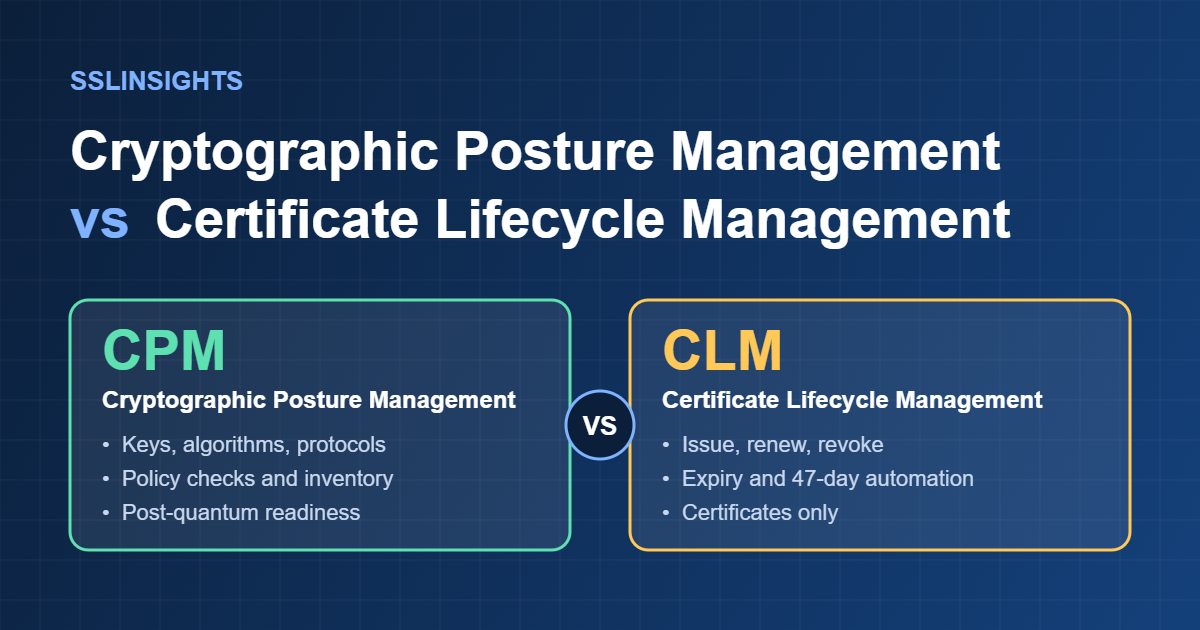
Certificate lifecycle management (CLM) keeps TLS certificates issued, installed and renewed before they expire. Cryptographic posture management (CPM) covers more ground: it continuously inventories every certificate, key, algorithm, library and protocol, then checks each one against a written policy. CLM prevents expiry outages. CPM finds weak or outdated cryptography. They work as layers, not rivals.
Two dated events explain why the question is getting louder. Public certificate lifetimes are shrinking toward 47 days by March 2029, which punishes manual renewal. And on October 27, 2026, NIST finalized IR 8547, which deprecates RSA, ECDSA and other quantum-vulnerable public-key algorithms after 2030 and disallows them after 2035 under NIST standards. The first deadline stresses CLM. The second stresses CPM. The sections below show where each discipline starts and stops, and which one a given team should build first.
What Is Certificate Lifecycle Management?
Certificate lifecycle management is the practice of discovering, requesting, installing, monitoring, renewing and revoking digital certificates across an organization, usually with automation. Its scope is the certificate itself: who owns it, where it runs, when it expires and whether the replacement actually landed. CLM reliably answers one operational question: will this certificate still work next month?
A typical CLM process covers five stages:
- Discovery: find certificates across servers, load balancers, cloud services and appliances, including ones nobody registered.
- Issuance and deployment: request from a certificate authority, prove domain control, and install the result, often through the ACME protocol.
- Monitoring: track expiry dates and chain health, and alert at set intervals.
- Renewal and replacement: reissue before expiry and confirm the new certificate is the one serving traffic.
- Revocation: pull a certificate early after a key compromise or a change of domain ownership.
Small sites often get CLM without noticing, because a managed host or CDN renews certificates automatically. Larger estates need it as a deliberate program, since certificates accumulate across teams, clouds and appliances. To see what any live certificate currently reports, including its expiry date and issuer, the free SSLInsights SSL Checker Tool is a quick starting point. Many CLM tools also record the key size and signature algorithm of each certificate, but they generally stop at the certificate's edge.
What Is Cryptographic Posture Management?
Cryptographic posture management is the continuous practice of finding every cryptographic asset an organization uses, recording it in an inventory, measuring it against policy and fixing the gaps in priority order. It treats cryptography the way vulnerability management treats software flaws: as a standing program with owners and metrics, not a one-time audit.
A CPM program typically brings these asset types into one view:
- Certificates, both public and private.
- Private and secret keys, and where they are stored.
- Algorithms and key sizes in use.
- Protocol versions and cipher suites negotiated on the network.
- Cryptographic libraries, in your own code and inside third-party binaries.
- Hardware security modules and key vaults.
The inventory has an open format. A Cryptography Bill of Materials (CBOM), part of the OWASP CycloneDX standard, describes algorithms, keys and certificates and how they relate to software components. In practice a CBOM is the data, and CPM is the program that keeps it current, compares it with policy and drives fixes. Weak algorithms are the usual first finding, and our guide to the risks of weak encryption explains why they linger.
One caution on vocabulary: the term is young and vendors use it unevenly. Some apply "posture management" to products that mostly track certificates. A fair test is to ask whether a tool can find a deprecated protocol on a server or an old algorithm inside a library, or whether it only reports on certificates.
How Do CPM and CLM Differ?
CLM manages one asset type, certificates, to keep them valid. CPM manages every cryptographic asset to keep them strong and compliant. The difference is the question each asks: CLM asks whether a certificate will still be valid tomorrow, while CPM asks whether the cryptography behind it, and everything around it, is still acceptable.
| Dimension | CLM | CPM |
|---|---|---|
| Core question | Will this certificate be valid and installed on time? | Is our cryptography strong, current and within policy? |
| Assets covered | X.509 certificates, from public and private CAs | Certificates plus keys, algorithms, protocols, libraries and key stores |
| Typical trigger | Expiry incidents, shorter lifetimes, audit findings on renewals | Post-quantum planning, inventory requirements, weak-cryptography findings |
| Main activity | Discover, issue, deploy, renew, revoke | Discover, inventory, assess against policy, prioritize, remediate, monitor |
| Failure it prevents | Outages from expired or mismatched certificates | Silent exposure from deprecated algorithms, forgotten keys and stale protocols |
| Success measure | No expiry incidents; share of certificates on automation | Inventory coverage; share of assets within policy; migration progress |
The overlap is real. Both start with discovery, and a good CLM tool can flag a weak signature algorithm on a certificate. The split shows up at the certificate's edge: an RSA key embedded in an application, a library that still allows an obsolete cipher, or a server negotiating TLS 1.0 never passes through a renewal workflow.
Can a Well-Managed Certificate Still Sit on Weak Cryptography?
Yes. Certificate management tracks validity, not the strength of everything around the certificate. A certificate can renew on schedule and chain cleanly to a trusted root while the server behind it accepts obsolete protocol versions or relies on a key type that NIST has scheduled for deprecation. Validity and strength are separate properties, and CLM measures the first.
Hypothetical example: a retailer automates renewal for 300 certificates and records no expiry incident for a year. A cryptographic audit then turns up three issues its certificate dashboard never showed: a payment appliance that still accepts TLS 1.0, an internal service with an RSA private key committed to a code repository, and a vendor library that only negotiates classical key exchange. None of these is an expiry problem. All three are posture problems.
NIST's final IR 8547 draws a line that fits this split. Authentication, including the signature on a certificate, is not exposed to harvest-now-decrypt-later collection, because a signature only needs to hold at the moment it is checked. Key establishment is exposed, because encrypted traffic recorded today could be decrypted once quantum computers mature. NIST still treats signature migration as urgent, since it takes years and many parties must move together. In practice, certificate cadence is a CLM concern, while the key exchange a server negotiates is something only a protocol-level inventory reveals. NIST names TLS as an early migration priority and points to TLS 1.3 with hybrid ML-KEM key exchange as a near-term path. Much of this rests on public-key algorithms such as RSA, covered in our explainer on what an RSA key is used for.
How Do the 2026 to 2029 Deadlines Map to Each Discipline?
Two separate clocks are running. The CA/Browser Forum's validity schedule shortens how long public TLS certificates last, which raises renewal volume and rewards CLM automation. NIST's post-quantum timeline sets when RSA, ECDSA and similar algorithms are deprecated and then disallowed, which rewards CPM-style inventory and prioritization.
| Milestone | Date | What changes | Mostly tests |
|---|---|---|---|
| CA/Browser Forum SC-081v3, step 1 | March 15, 2026 | Maximum public TLS certificate validity drops to 200 days | CLM |
| SC-081v3, step 2 | March 15, 2027 | Maximum validity drops to 100 days | CLM |
| SC-081v3, step 3 | March 15, 2029 | Maximum validity drops to 47 days; reuse of domain validation data falls to 10 days | CLM |
| NIST IR 8547 (final, October 27, 2026) | After 2030, then after 2035 | RSA, ECDSA, EdDSA and classical key establishment are deprecated, then disallowed under NIST standards | CPM |
| Executive Order 14412 and OMB M-26-15 | December 31, 2030 and December 31, 2031 | US federal high-value and high-impact systems adopt post-quantum key establishment, then signatures | CPM |
| Federal TLS 1.3 requirement | January 2, 2030 | US federal agencies must support TLS 1.3 | CPM |
The CA/Browser Forum steps arrive on fixed March dates, so CLM readiness can be tested against them. The ballot behind the schedule passed in April 2025 with all four browser vendors that voted (Apple, Google, Microsoft and Mozilla) in favor. Our guide to SSL/TLS changes in 2026 walks through the schedule from a site owner's perspective.
NIST's dates bind federal systems directly. For everyone else they work as a planning reference, though NIST notes that organizations working with the federal government will be affected as well.
One detail is worth rechecking if a plan was built on the 2024 draft. That draft gave algorithms at 128-bit strength and above, such as ECDSA with the P-256 curve, a path of disallowance after 2035 with no deprecation step in 2030. The final report applies deprecation after 2030 to ECDSA, EdDSA and RSA at every approved strength, so older planning documents may understate the near-term work.
Which Should You Build First?
Build CLM first if certificates cause your outages, and add CPM once you need answers about keys, algorithms and protocols outside certificates. Small sites rarely need a dedicated CPM program. Regulated organizations, software vendors and anyone protecting data that must stay confidential for a decade or more should start a cryptographic inventory now.
| Situation | Start with | Why |
|---|---|---|
| One site or a few, on a managed host or CDN | Host-managed or ACME auto-renewal, plus periodic checks | Few assets; the realistic risk is a missed renewal |
| Dozens to hundreds of certificates across teams, clouds and appliances | A CLM platform with discovery | Unknown certificates and expiry outages are the main exposure |
| Certificates already automated, no view beyond them | Add CPM discovery and a CBOM-style inventory | The remaining gaps sit in keys, libraries and protocols |
| Regulated sector, or data that must stay confidential for 10+ years | CLM plus CPM, inventory first | Harvest-now-decrypt-later pulls key-exchange migration forward |
| Software vendor, embedded or long-lived devices | CPM with code and binary discovery | Cryptography is built in, and replacing it later is slow |
A workable sequence for most teams:
- Inventory every certificate, including ones issued outside central IT.
- Automate renewal with ACME wherever the CA and server support it.
- Write a one-page cryptographic policy: approved algorithms, minimum key sizes, allowed TLS versions and maximum certificate lifetimes.
- Extend discovery to keys, libraries and protocol configurations, and record the results in a standard inventory format.
- Rank findings by how long the protected data must stay secret and how exposed the system is, then fix in that order.
This inventory-first order matches NIST's own framing. The National Cybersecurity Center of Excellence runs a Migration to Post-Quantum Cryptography project with a discovery workstream built around cryptographic inventory tools and risk-based prioritization. Teams without in-house PKI skills sometimes buy the certificate side as a service, a model our PKI-as-a-Service explainer covers.
What Are the Limits and Trade-Offs?
Neither discipline is a finished answer, and a posture program adds its own failure modes. Five limits are worth planning for:
- Discovery is never complete. Ephemeral workloads, third-party binaries and externally managed services hide assets, so a posture score is only as good as inventory coverage.
- Findings need owners. A program that ranks thousands of weak assets and has nobody assigned to fix them produces reports, not posture.
- Hybrid cryptography is a trade. NIST says hybrid modes add complexity and are typically temporary measures, and it leaves the decision to each application.
- Tools can fragment. A certificate platform and a separate posture product can keep two inventories that disagree unless they integrate.
- Not every environment needs CPM. A five-site business gains more from dependable auto-renewal than from a posture program.
The property that decides how fixable the findings are is crypto-agility. NIST's CSWP 39 defines it as the ability to replace or adapt cryptographic algorithms in protocols, applications, hardware and infrastructure while keeping systems running. A posture program can only fix what can be changed, and systems that hard-code algorithms turn every finding into a rewrite.
Frequently Asked Questions
Does cryptographic posture management replace certificate lifecycle management?
No. CLM remains the control that issues, renews and revokes certificates, and a CPM program normally relies on it. CPM adds visibility and policy checks across keys, algorithms, protocols and libraries that CLM was never designed to see. Think of CLM as one control inside a wider posture program.
Is a CBOM the same as cryptographic posture management?
No. A CBOM is an inventory of cryptographic assets in a standard format such as CycloneDX. Posture management is the ongoing program that keeps that inventory current, measures it against policy and tracks fixes. An inventory without a program ages quickly, and a program without an inventory has nothing to measure.
Does a small website need cryptographic posture management?
Usually not. A site with a few certificates on a managed host or CDN gains more from reliable automatic renewal and an occasional check of its TLS configuration. The calculation changes if the organization runs its own servers at scale, ships software that embeds cryptography, or protects data that must stay confidential for many years.
Does a shorter certificate lifetime make a site quantum-safe?
No. Shorter lifetimes limit how long a compromised key or outdated validated information stays trusted, and the CA/Browser Forum also lists faster algorithm transitions among the benefits in its ballot. They do not change the algorithm. As of this writing, publicly trusted TLS certificates are still signed with classical algorithms such as RSA or ECDSA, so quantum readiness is a separate track that starts with knowing where those algorithms are used.
Where should a team start with a cryptographic inventory?
Start where the data already exists: certificate stores, TLS endpoints and key vaults. Then extend to code and third-party binaries. A CBOM gives the results a standard shape, and the NCCoE discovery workstream described above is a useful public reference for how inventory tools are tested.
What is crypto-agility and why does it come up?
It is the ability to change algorithms without interrupting running systems. It comes up because every posture finding, from a deprecated cipher to a classical key exchange, eventually requires a change. The easier the change, the faster the posture improves.