Verified by SSL Insights Editorial Team - Last reviewed: October 2026 | Web Security Expert, SSLInsights.com | 15+ years combined experience across SSL/TLS security and PKI implementation.
SSL/TLS in 2026 is defined by one change more than any other: certificate lifetimes just dropped from 398 days to 200 days, effective March 15, 2026, under CA/Browser Forum Ballot SC-081v3. Alongside that shift, Certificate Authorities now validate every domain from multiple independent network locations, TLS 1.3 has become the practical baseline while TLS 1.2 still lingers on older servers, and post-quantum key exchange already protects a majority of hybrid TLS 1.3 traffic through providers like Cloudflare.
Website owners who still renew certificates by hand face the sharpest adjustment. Validity windows keep shrinking through 2029, and that trend, more than any single vulnerability, is reshaping how certificate management works this year.
What is SSL/TLS?
SSL (Secure Sockets Layer) and TLS (Transport Layer Security) are cryptographic protocols that encrypt data moving between a browser and a server. TLS replaced SSL years ago - TLS 1.2 and TLS 1.3 are what modern servers actually run - but "SSL certificate" remains the everyday term for the digital file that proves a website's identity and enables that encryption.
What Are the Biggest SSL/TLS Changes in 2026?
The single biggest change is the certificate lifetime cut: as of March 15, 2026, the maximum validity for publicly trusted TLS certificates dropped from 398 days to 200 days. Three other shifts matter almost as much for day-to-day site security.
- Certificate lifetimes shrink on a fixed schedule - 200 days now, 100 days in 2027, 47 days by 2029.
- Certificate Authorities must corroborate domain validation from multiple independent network locations (MPIC).
- Post-quantum key exchange (ML-KEM) is rolling into TLS 1.3 handshakes at major CDNs and browsers.
- Reuse of organization details for OV/EV certificates dropped from 825 days to 398 days, forcing more frequent re-verification.
How Fast Are Certificate Lifetimes Actually Shrinking?
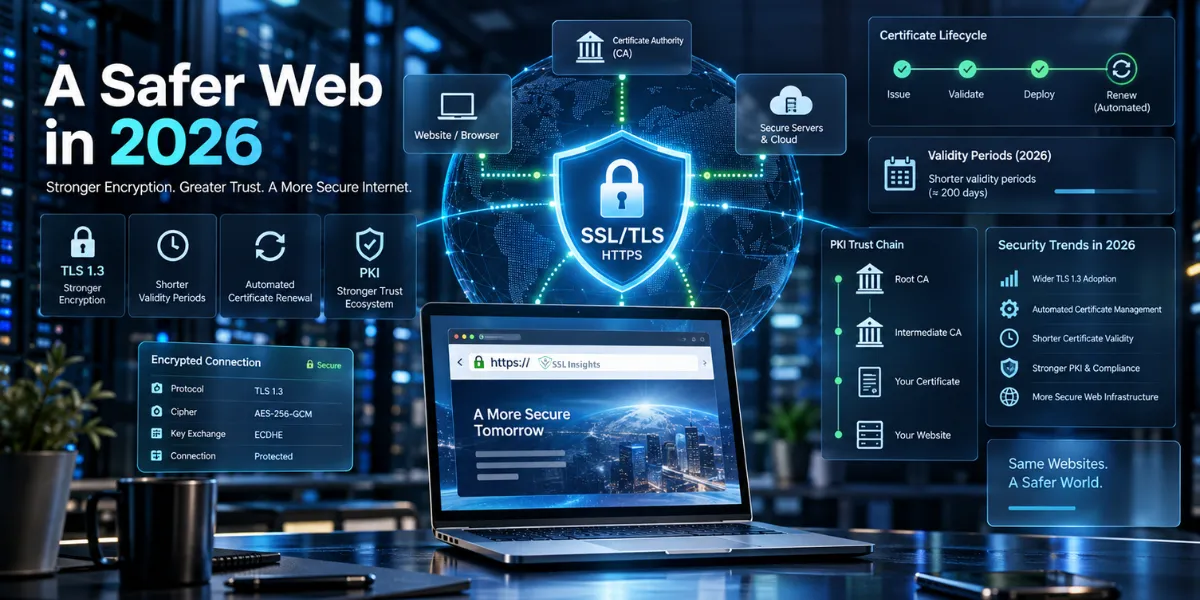
Certificate lifetimes are shrinking in three fixed steps between 2026 and 2029, not all at once. The schedule comes from CA/Browser Forum Ballot SC-081v3, approved in April 2025.
| Effective Date | Max Certificate Validity | Domain Validation Reuse |
| March 15, 2026 | 200 days | 200 days |
| March 15, 2027 | 100 days | 100 days |
| March 15, 2029 | 47 days | 10 days |
Sectigo describes the endpoint plainly: by 2029, a 47-day maximum accommodates roughly a one-month renewal cadence, according to Sectigo's rollout guide (October 2025). Compared with today's 398-day cycle, that's roughly eight times more renewal events for every certificate a site depends on.
A quick check with the SSLInsights SSL Checker Tool shows exactly when a live certificate expires and which validation level it uses, which is worth doing before the next renewal cycle catches anyone off guard.
Practitioner's Note - SSLInsights Team:
Treat March 2026 as the wake-up call, not 2029. Teams still renewing certificates by hand should move to ACME-based automation now - 200-day cycles are already twice as frequent as what most manual processes were built to handle.
Behind the Scenes: How Certificate Authorities Now Validate Domains
Certificate Authorities now confirm every domain validation and CAA check from multiple, geographically separate network locations before issuing a certificate. This is called Multi-Perspective Issuance Corroboration, or MPIC.
MPIC exists to stop attackers who manipulate internet routing (BGP hijacking) to trick a CA into validating a domain they don't actually control. Checking from several vantage points at once makes that kind of spoofing far harder to pull off undetected.
- Most site owners notice nothing - validation still completes automatically during issuance or renewal.
- Sites with strict firewall rules or region-locked DNS may see validation failures if they block traffic from unfamiliar regions.
- The rollout is phased: CAs expanded from two perspectives in 2025 toward broader, multi-region coverage through 2026.
Which TLS Version Should Websites Use in 2026?
TLS 1.3 is the version websites should run in 2026. It negotiates connections faster, drops outdated cipher suites, and is the protocol every major browser and CDN optimizes for by default.
| Attribute | TLS 1.2 | TLS 1.3 |
| Handshake speed | 2 round trips | 1 round trip (0-RTT resume) |
| Weak cipher support | Allowed if configured | Removed by design |
| Current status | Still widely deployed, aging | Practical baseline for 2026 |
TLS 1.2 is not broken, and turning it off entirely can still break traffic from older devices, some payment terminals, and legacy internal systems. The safer 2026 posture is TLS 1.3 as the default with TLS 1.2 kept only where a real compatibility need exists.
Trend Watch:
Hybrid post-quantum key exchange already secures a majority of TLS 1.3 connections through major CDNs, even though most site owners never touch a configuration panel to enable it.
Is Post-Quantum Cryptography Already Affecting SSL/TLS?
Yes, but only on the session key exchange side so far, not on certificate signatures. NIST finalized its first post-quantum cryptography standards, including ML-KEM for key exchange, in August 2024, and adoption moved quickly after that.
- ML-KEM (FIPS 203) is already deployed at scale by Cloudflare, Chrome, Firefox, Microsoft, and AWS to protect the encryption layer of HTTPS sessions.
- Sites behind these platforms get this protection automatically, with no certificate changes required.
- Certificate signatures themselves - the part that proves domain identity - are still classical (RSA/ECDSA) in public production; post-quantum signature algorithms are still maturing.
The driving concern is "harvest now, decrypt later": encrypted traffic captured today could be decrypted retroactively once quantum computers mature enough, as NIST's finalized FIPS 203/204/205 standards were designed to prevent (August 2024). Most sites don't need to act on certificate signatures yet - but organizations with long-confidentiality data should track the roadmap closely.
What SSL Certificate Risks Should Website Owners Watch For?
The biggest practical risk in 2026 isn't a new attack technique - it's operational failure caused by faster renewal cycles catching manual processes off guard.
- Unplanned expirations: 200-day (soon 100-day) cycles mean roughly twice the renewal events per year compared to 2025.
- Shorter validation reuse: OV/EV organization details now expire after 398 days instead of 825, adding re-verification steps.
- Firewall or DNS restrictions that block MPIC's multi-region validation checks, silently failing new issuances.
- Legacy TLS 1.0/1.1 support left enabled on older servers, which most browsers already refuse to negotiate.
Reviewing current SSL/TLS certificate statistics is a useful way to benchmark how a site's certificate posture compares with broader adoption trends before deciding where to prioritize fixes.
Reality Check:
A shorter certificate lifetime lowers the damage window if a private key leaks - but it also multiplies renewal events roughly eightfold by 2029. Teams without automation will feel that trade-off first.
Preparing Your Website for the 2026 Changes
Preparing for shorter cycles comes down to automation and visibility. Start with these five steps, in order of urgency.
- Inventory every certificate across web servers, load balancers, APIs, and internal tools - you can't automate what you can't see.
- Switch to ACME-based automated renewal wherever manual processes still exist.
- Confirm your DNS and firewall rules allow validation traffic from multiple regions, so MPIC checks don't silently fail.
- Test and default to TLS 1.3, keeping TLS 1.2 only for confirmed legacy compatibility needs.
- Follow the NIST and CA/Browser Forum post-quantum roadmap so certificate signature changes aren't a surprise later.
"The organizations struggling most in 2026 aren't the ones without security budgets - they're the ones still tracking certificate expiry dates in a spreadsheet." - SSLInsights Team
For a broader view of certificate types and which validation level fits a given site, SSLInsights maintains an updated breakdown of SSL certificate types alongside its free checker tools.
Frequently Asked Questions
Will my current SSL certificate be revoked early under the new rules?
No. The lifetime reduction applies to newly issued and renewed certificates from each effective date onward, not certificates already in use. Existing certificates run until their original expiry date.
Does a shorter certificate validity period cost more?
Not directly. Most providers price by certificate type rather than by validity length, though some multi-year discount plans may need restructuring as annual and multi-year purchasing options adjust to the new maximums.
Do free certificates like Let's Encrypt follow the same lifetime rules?
Yes. Let's Encrypt already issues certificates with a 90-day lifetime, shorter than the new 200-day maximum, and its ACME-based automation is the model the rest of the industry is now moving toward.
Is TLS 1.2 still secure enough to leave enabled in 2026?
TLS 1.2 configured with strong cipher suites is not inherently broken, but it lacks TLS 1.3's forward-secrecy-by-default design. Keep it only for confirmed legacy compatibility, with TLS 1.3 as the default.
Can hosting providers auto-renew certificates for me?
Most managed hosts and CDNs already automate renewal through ACME integrations, so many site owners won't notice the shorter cycles at all. Self-managed servers are where manual renewal risk concentrates.
What happens if a certificate expires without warning?
Browsers block access with a full-page warning and most traffic simply bounces. Set expiration alerts at 30, 15, and 7 days out, and verify automation actually completed rather than assuming it did.
Should small websites worry about post-quantum certificates yet?
Not urgently. Post-quantum protection for session encryption is already handled automatically by most CDNs and browsers. Certificate signature changes are still maturing industry-wide, so small sites can wait for clearer CA guidance.