
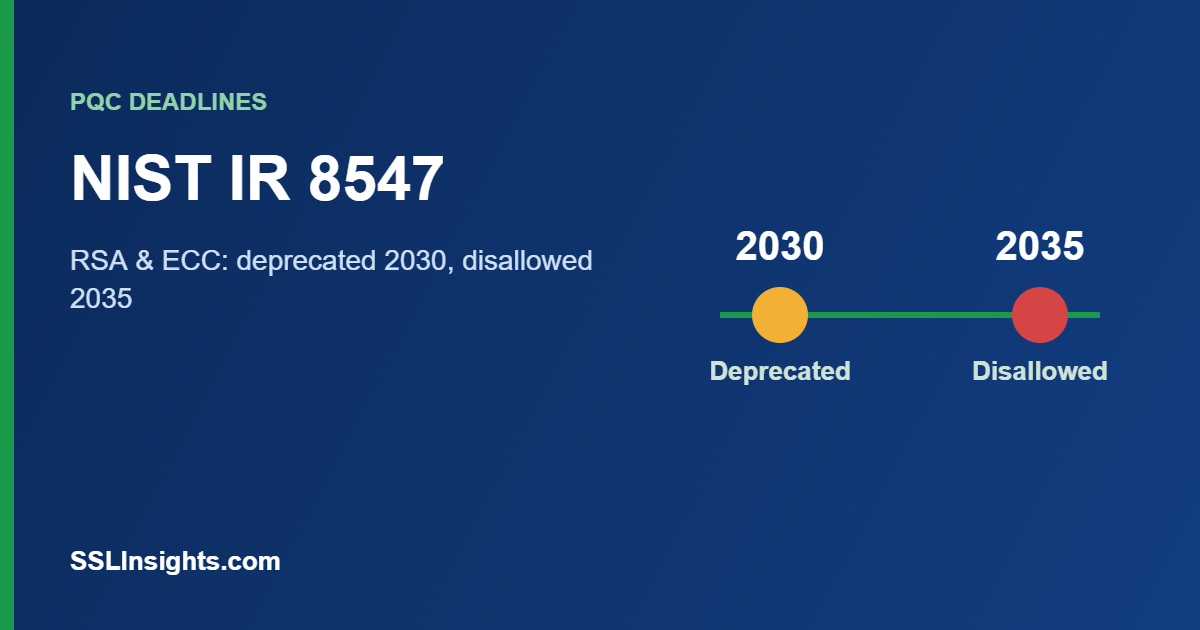
NIST IR 8547 is NIST's final plan for retiring quantum-vulnerable public-key algorithms. RSA and elliptic-curve cryptography are deprecated after 2030 and disallowed after 2035.
It is NIST guidance, and browsers and the CA/Browser Forum set their own rules for public SSL certificates. It does set a timeline that is turning into vendor requirements.
What is NIST IR 8547?
NIST IR 8547 is titled Transition to Post-Quantum Cryptography Standards. NIST published the final version on 27 October 2026.
It replaces the draft released on 12 November 2024, which NIST withdrew the same day. Some older guides still call it a draft.
What are the 2030 and 2035 deadlines?
Quantum-vulnerable public-key algorithms are deprecated after 2030 and disallowed after 2035, regardless of key size. A deprecated algorithm can still be used, but the data owner must examine the risk and decide.
| Date | Status | Applies to |
|---|---|---|
| After 2030 | Deprecated | RSA, ECC and other quantum-vulnerable public-key algorithms |
| After 2035 | Disallowed under NIST standards and guidelines | The same algorithms |
| 31 December 2030 | Post-quantum key establishment | Federal high value assets and high-impact systems |
| 31 December 2031 | Post-quantum digital signatures | The same federal systems |
Digital signature algorithms are covered, so signing workflows such as code signing need a plan too.
Which algorithms are affected, and which are not?
The report lists RSA, ECDSA, ECDH and finite-field Diffie-Hellman as quantum-vulnerable. Symmetric algorithms such as AES-256 are not part of this transition.
| Job | Affected algorithms | Post-quantum replacement |
|---|---|---|
| Key establishment | RSA, Diffie-Hellman, ECDH | ML-KEM (FIPS 203) |
| Digital signatures | RSA, ECDSA | ML-DSA (FIPS 204) and SLH-DSA (FIPS 205) |
| Symmetric encryption and hashing | None named, such as AES-256 | No change under this transition |
If you are unsure how your certificates use these algorithms, read the ECC vs RSA comparison.
Does NIST IR 8547 apply to my SSL certificate?
Not directly. It governs NIST standards and federal systems.
Browsers and the CA/Browser Forum decide what public SSL certificates may use. Even so, the dates are becoming vendor requirements, so read the other 2026 SSL/TLS changes in the same planning cycle.
Warning Sign
NIST warns that earlier cryptographic transitions took 10 to 20 years. Treat 2030, not 2035, as your planning date.
What should I do now?
Start by finding where you use RSA and ECC keys. Then rank the systems that protect the longest-lived data.
- List every certificate with its key type and key size.
- Mark long-lived and high-value systems, such as VPNs, internal PKI, code signing and HSM-backed keys.
- Create new keys and requests with the CSR generator tool when you rotate.
- Ask your CA and vendors for their post-quantum roadmap.
- Test hybrid certificates in a lab. They combine a classical signature with a post-quantum one.
Diagnostic Tip
Run openssl x509 -in cert.pem -noout -text on each certificate file. Read the Public Key Algorithm and Public-Key lines for the key type and size.
How does crypto agility connect to 47-day certificates?
Crypto agility is the ability to change algorithms without rebuilding your systems. Two deadlines test it: 47-day certificates by 2029 and the post-quantum move by 2030.
The 47-day lifespan schedule lists the dates. Automation built for frequent renewals also makes an algorithm change easier.
FAQ
Is NIST IR 8547 final or still a draft?
It is final. NIST published it on 27 October 2026 and withdrew the November 2024 draft.
Is RSA-2048 insecure today?
Under NIST's timeline, RSA-2048 is deprecated after 2030 and disallowed after 2035. Until then, plan the migration.
Do I need a post-quantum SSL certificate now?
Not because of NIST IR 8547 alone. Browsers and the CA/Browser Forum set the rules for public SSL certificates, so watch their announcements.
What is the difference between deprecated and disallowed?
Deprecated algorithms may still be used if the data owner reviews the risk. Disallowed algorithms may not be used under NIST standards and guidelines.
Does NIST IR 8547 affect AES-256?
No. Symmetric algorithms such as AES-256 are not part of this transition.