
Verified by SSL Insights Editorial Team - Last reviewed: October 2026 | 10+ years in PKI and TLS configuration
Quick Definition
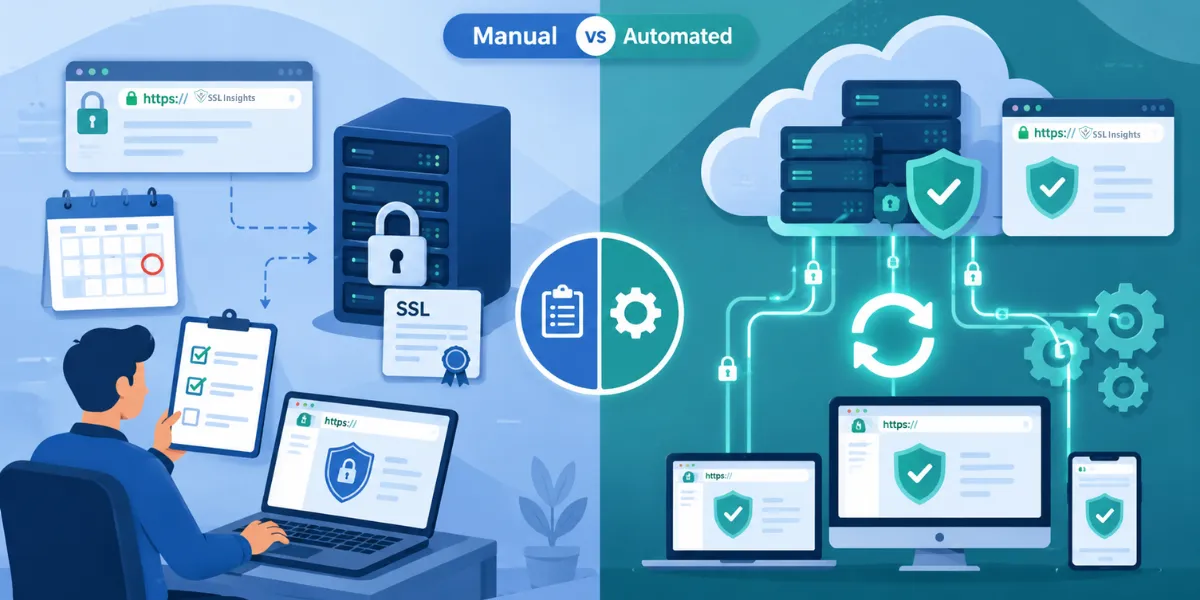
Manual SSL certificate management means a person tracks expiration dates, requests renewals, and installs each certificate by hand, while automated management uses software and protocols such as ACME to handle issuance, renewal, and installation without ongoing human involvement. For a handful of certificates renewed once a year, manual management can still work. Once certificate lifespans drop to 200 days and eventually 47 days under new CA/Browser Forum rules, the renewal workload multiplies, and manual tracking becomes the leading cause of preventable outages. Most organizations running more than a dozen certificates are better served by automation.
SSL certificate management is the set of processes used to issue, install, monitor, renew, and revoke TLS certificates across an organization's servers and domains. Manual management relies on people remembering expiration dates and acting on them in time. Automated management replaces that human step with software that renews certificates on a fixed schedule.
Quick Verdict
Choose Manual SSL Management if:
✓ You manage one or two websites
✓ Certificate renewals are infrequent
✓ You are comfortable renewing certificates yourself
Choose Automated SSL Management if:
✓ You manage multiple domains or servers
✓ Your organization renews certificates regularly
✓ You want to eliminate expiration-related outages
Bottom Line:
Automation becomes the better long-term choice as certificate counts and renewal frequency increase.
What Is the Difference Between Manual and Automated SSL Certificate Management?
Manual management puts a person at every step: generating the CSR, submitting it to a Certificate Authority, downloading the issued certificate, and installing it on each server. Automated management replaces that chain with software, typically an ACME client paired with a Certificate Authority that supports automated domain validation.
SSLInsights covers the full setup process in its ACME protocol setup guide, which walks through configuring an ACME client to handle renewal without manual intervention. The core distinction is timing: automation renews a certificate before it expires, every time, without depending on someone checking a calendar.
Why Is Automated Certificate Management Becoming the Industry Standard?
Shorter certificate lifespans are forcing the shift. The CA/Browser Forum approved Ballot SC-081v3 in April 2025, which according to the ballot record published on the CA/Browser Forum site (April 2025) cuts maximum public certificate validity from 398 days down to 47 days by 2029, starting with a reduction to 200 days on March 15, 2026.
That schedule turns an annual task into a recurring one. Under a 47-day lifespan, a team managing 1,000 certificates faces roughly eight times the renewal events it handles today, according to CyberArk's analysis of the new timeline (October 2025). Outages tied to expired certificates are already common: 72% of organizations experienced at least one certificate-related outage in the past year, with 34% suffering multiple, according to CyberArk's 2025 State of Machine Identity Security Report (October 2025).
The pattern shows up across well-known incidents too, not just survey data. SSLInsights' own outage prevention guide documents cases at Microsoft, Spotify, and Equifax where an expired or unmonitored certificate caused service disruption or, in Equifax's case, masked unauthorized access for 19 months.
How Much Does Manual SSL Management Actually Cost?
The average organization experiences three certificate-related outages per year, each lasting around four hours, at an estimated $9,000 per minute of downtime, according to CyberArk's 2025 research. Labor costs compound the problem separately from outage costs.
A Forrester Total Economic Impact study of Sectigo Certificate Manager found that automating certificate lifecycle management saved organizations $965,000 in renewal labor costs over three years, according to Sectigo's published summary of the study (July 2025). Visibility is part of the cost too: only 36% of companies use a dedicated certificate lifecycle management platform, according to Keyfactor's research cited by FlareWarden (January 2026), with most others relying on spreadsheets or calendar reminders that don't scale.
| Factor | Manual Management | Automated Management |
| Renewal at 200-day or 47-day lifespans | Requires repeated manual tracking, multiple times a year | Renews automatically on schedule, no recurring labor |
| Risk of human error | High - missed dates, wrong domains, lost ownership | Low - software follows the same steps every time |
| Labor cost over 3 years | Scales directly with certificate count and renewal frequency | Largely fixed after initial setup |
| Scalability across hundreds of certificates | Breaks down quickly past a few dozen certificates | Designed for hundreds or thousands of certificates |
| Initial setup effort | Minimal - issue a certificate, install it, done | Moderate - requires ACME client or CLM platform setup |
At a Glance
Winner for Small Websites: Manual Management
Winner for Growing Businesses: Automated Management
Winner for Scalability: Automated Management
Winner for Reducing Outages: Automated Management
Best Long-Term Approach: Automated SSL Certificate Management
When Does Manual Certificate Management Still Make Sense?
Manual management isn't always wrong. A personal blog with one domain and a free certificate from Let's Encrypt may not justify setting up an ACME client and monitoring dashboard. Internal lab environments with no production traffic can sometimes tolerate the lower bar of manual renewal, provided someone actually owns the task.
The line to watch is certificate count and renewal frequency together. One certificate renewed once a year is a five-minute task. Ten certificates renewed every 47 days is a part-time job that nobody signed up for. Teams choosing manual management should still understand the basics covered in SSLInsights' guide on how Certificate Authorities issue and validate domains, since manual renewal still depends on getting domain control validation right every cycle.
When Should You Choose EssentialSSL Wildcard Over Positive SSL Wildcard?
Choose EssentialSSL Wildcard if you want a free PCI scan bundled in, or if the Comodo-branded trust seal matters for an e-commerce checkout flow. Sites processing card payments across several subdomains benefit most, since the scan flags basic vulnerabilities at no extra cost.
Choose PositiveSSL Wildcard if budget and warranty size matter more than bundled extras, since its $50,000 warranty is five times larger than Essential's. If you run more than one root domain, compare this against multi-domain SSL vs wildcard SSL before deciding, since wildcard certificates only cover subdomains of a single root.
What Should You Check Before Buying Either Wildcard Certificate?
Confirm your subdomain depth before purchasing. Both certificates secure only first-level subdomains, so admin.shop.yoursite.com would not be covered under a standard wildcard issued for yoursite.com.
If you manage subdomains two levels deep, such as dev.api.yoursite.com, check our guide on getting SSL certificates for subdomains before buying either product, since neither Positive nor Essential Wildcard reaches that deep automatically.
SSLInsights Observation
In our review of certificate lifecycle management practices, organizations rarely experienced outages because automation failed. Most outages occurred because certificates were never inventoried, renewal ownership was unclear, or manual tracking relied on spreadsheets and calendar reminders that eventually fell out of date.
The larger the certificate inventory, the greater the operational advantage of automation.
How Do You Move From Manual to Automated SSL Management?
- Inventory every certificate across production, staging, and internal tools - 53% of organizations cannot precisely quantify their own certificate inventory, according to Keyfactor's research cited by FlareWarden, so this step alone often surfaces forgotten certificates.
- Choose a Certificate Authority that supports the ACME protocol, since automation depends on machine-to-machine issuance rather than manual form submission.
- Install and configure an ACME client (such as Certbot or a vendor-specific agent) on each server, following a structured setup process rather than an ad hoc one.
- Set renewal thresholds well before expiration, typically 30 days out, so a failed automated attempt still leaves time for manual recovery.
- Add monitoring and alerting on top of automation, since automation reduces human error but doesn't eliminate the need to confirm renewals actually succeeded.
Teams comparing certificate types as part of this migration can reference SSLInsights' breakdown of DV vs OV certificates to confirm which validation level their automation workflow needs to support.
Researcher's Perspective
"The math changes completely once certificate lifespans drop below 100 days. A renewal process that worked well once a year quickly becomes difficult to sustain when certificates require renewal multiple times annually. At that point, automation is no longer just a convenience - it becomes an operational requirement."
- Priya Mervana, Security Researcher, SSLInsights
Key Takeaway
Manual SSL certificate management can still work for a small number of certificates.
However, as certificate lifetimes continue shrinking and organizations manage more domains, automation shifts from being a convenience to becoming an operational necessity.
The biggest advantage of automation is not speed - it is consistency and reduced risk of certificate-related outages.
Frequently Asked Questions
Is automated SSL certificate management more secure than manual management?
Generally yes, because automation removes the most common failure point: a person forgetting to renew on time. It also reduces configuration drift, since the same script issues and installs certificates the same way every cycle.
What is the ACME protocol and how does it relate to automation?
ACME (Automatic Certificate Management Environment) is the protocol that lets a server request, validate, and install a certificate from a Certificate Authority without manual steps. Let's Encrypt popularized it, and most automated certificate management today runs on top of it.
Can small websites get away with manual SSL management?
A single-domain site with one certificate can often manage manually, especially with calendar reminders set well ahead of expiration. The risk grows quickly once a site adds subdomains or a second server.
What tools handle automated certificate renewal?
Common options include Certbot for ACME-based renewal on individual servers, and dedicated certificate lifecycle management platforms for organizations managing certificates across many servers and cloud environments.
How often do SSL certificates need to be renewed in 2026?
Public certificates issued after March 15, 2026 are limited to a 200-day validity period under the CA/Browser Forum's phased schedule, down from the previous 398-day maximum. That period continues shrinking toward 47 days by 2029.
Does automation eliminate the need for certificate monitoring?
No. Automation reduces the chance of a missed renewal, but monitoring still confirms that each automated renewal actually completed and that the new certificate installed correctly across every server.