SSL / TLS Security
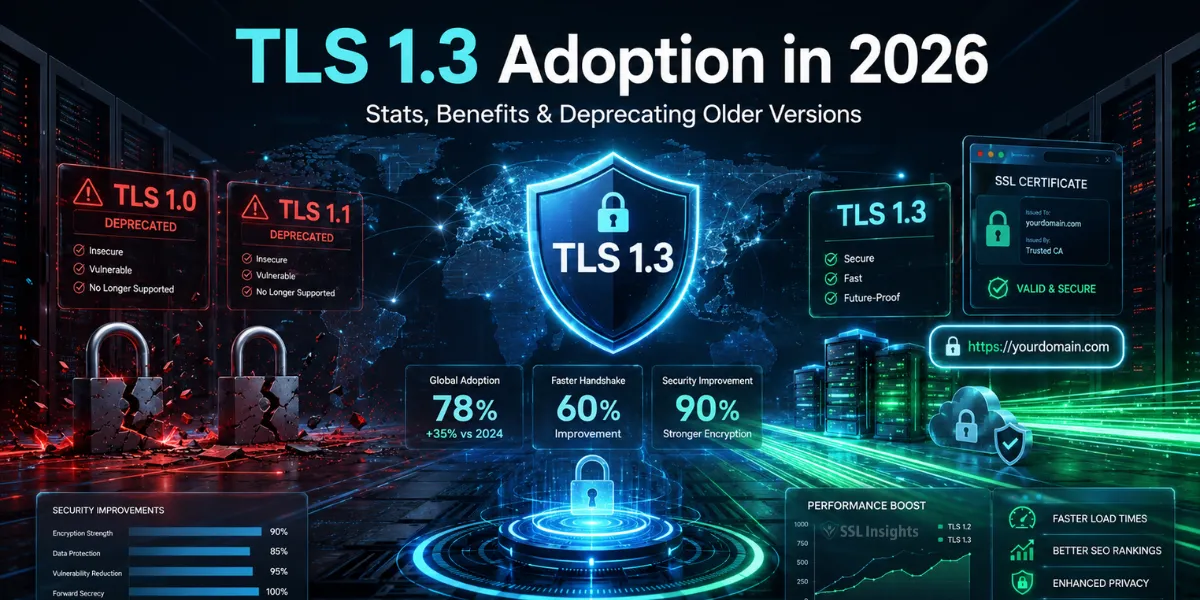
TLS 1.3 Adoption in 2026: Stats, Benefits & Deprecating Older Versions
A technical deep-dive into where TLS 1.3 stands today, what the migration data shows, and what every server admin needs to do before older protocols lock them out of compliance.
Verified by Priya Mervana - Last reviewed: October 2026 | Web Security Expert, SSLInsights.com | Based on 10+ years across SSL/TLS, encryption, and online privacy research.
QUICK DEFINITION
TLS 1.3
TLS 1.3 (Transport Layer Security version 1.3) is the current standard encryption protocol, standardized in August 2018 under RFC 8446. It reduces the connection handshake to a single round-trip, eliminates all legacy cipher suites, and mandates forward secrecy by design. The result: faster, cryptographically cleaner connections for every HTTPS session.
TLS 1.3 has reached 75.3% adoption among the world's top websites as of June 2025, up from near-zero in 2018. TLS 1.0 and 1.1 are formally deprecated under IETF RFC 8996, blocked by all major browsers, and banned outright by PCI DSS, NIST SP 800-52 Rev. 2, and HIPAA guidelines. In 2026, the protocol migration question is no longer "if" - it is "how fast" and "what remains exposed."
This guide covers the latest TLS 1.3 adoption numbers, its concrete security and performance benefits, and a step-by-step path for disabling older protocol versions before they create a compliance liability.
75.3%
Top websites supporting TLS 1.3 (Qualys SSL Pulse, Jun 2025)
90%
Browser adoption of TLS 1.3 by 2025
2018
Year TLS 1.3 was standardized as RFC 8446
RFC 8996
IETF standard formally deprecating TLS 1.0 & 1.1
What Is the Current TLS 1.3 Adoption Rate in 2026?
According to Qualys SSL Pulse, which monitors the top 150,000 websites from the Tranco list, 75.3% of surveyed sites supported TLS 1.3 as of June 2025. Browser-side adoption is even higher - roughly 90% of browsers negotiate TLS 1.3 when servers allow it, per data reviewed by security researchers in 2025.
At the same time, 100% of tracked sites still support TLS 1.2, reflecting enterprise dependency on backward compatibility. TLS 1.0 and 1.1, however, have effectively vanished from compliant environments: all four major browser families (Chrome, Firefox, Safari, Edge) disabled both protocols between March and April 2020, and the IETF formalized their removal in RFC 8996 (March 2021).
How Does TLS 1.3 Actually Improve Security Over TLS 1.2?
TLS 1.3 removes the entire negotiation surface that attackers exploited in older protocols. It eliminates RSA key exchange, CBC cipher modes, RC4, SHA-1, MD5, and all cipher suites without forward secrecy - a list that covers every known downgrade attack vector from POODLE to BEAST to FREAK.
In practical terms, TLS 1.3 only permits five cipher suites, all of which use authenticated encryption with additional data (AEAD). Forward secrecy is no longer optional; it is built into every session by default. If a private key is later compromised, no previously recorded session can be decrypted - a guarantee TLS 1.2 cannot make in all configurations.
Does TLS 1.3 Make Connections Noticeably Faster?
Yes - measurably so. TLS 1.2 requires two round-trips before application data flows. TLS 1.3 completes the handshake in one round-trip (1-RTT). For returning visitors, 0-RTT resumption can send application data in the very first packet, eliminating handshake latency entirely.
Laboratory benchmarks from SANS Institute testing show TLS 1.3 connections averaging 43.3 per second versus 39.5 per second for TLS 1.2 under identical conditions - a roughly 10% throughput gain. For high-traffic services or latency-sensitive APIs, the difference compounds at scale. Content delivery networks drove early TLS 1.3 adoption precisely because of this edge.
Secure Your Website Today
Get a TLS 1.3-Ready SSL Certificate
Every certificate sold through SSLInsights.com is fully compatible with TLS 1.3. Protect your visitors, pass compliance checks, and remove browser security warnings.
Starting at just $7.95/year - up to 87% off multi-year plans
Trusted by 12,000+ subscribers · Sectigo, DigiCert, GlobalSign & more
TLS 1.3 vs. TLS 1.2 vs. TLS 1.0/1.1: Side-by-Side Comparison
The table below captures the practical differences across security, performance, and compliance status. Use it as a quick reference for audit conversations or server configuration decisions.
| Feature | TLS 1.0 / 1.1 | TLS 1.2 | TLS 1.3 |
| Standardized | 1999 / 2006 | 2008 | 2018 (RFC 8446) |
| IETF Status | Deprecated (RFC 8996) | Active (aging) | Current Standard |
| Browser Support | Blocked (all major) | Supported | Preferred (90% adoption) |
| Handshake Round-trips | 2 RTT | 2 RTT | 1 RTT (0-RTT resumption) |
| Forward Secrecy | Optional / Weak | Optional | Mandatory |
| Cipher Suites | Many (incl. RC4, DES) | Many (incl. weak modes) | 5 (AEAD only) |
| Known Attacks | POODLE, BEAST, CRIME | Fewer - still some configs | None published to date |
| PCI DSS Compliance | Banned (since 2018) | Minimum requirement | Recommended |
| NIST SP 800-52 Rev. 2 | Prohibited | Permitted | Recommended |
| Post-Quantum Readiness | None | Limited (external tooling) | Hybrid mode testing underway |
Which Regulations Now Require TLS 1.2 or Higher?
Multiple major compliance frameworks have drawn hard lines on protocol versions. Understanding TLS 1.2 vs. TLS 1.3 differences is not just a technical exercise - it is a compliance obligation for any organization handling payment, health, or federal data.
The three most cited frameworks are PCI DSS, NIST, and HIPAA. PCI DSS has required disabling TLS 1.0 since June 2018 and treats TLS 1.2 as the minimum for cardholder data environments. NIST SP 800-52 Rev. 2 prohibits TLS versions below 1.2 for U.S. federal systems and contractors. HIPAA-covered entities and business associates that handle protected health information (PHI) fall under the same expectation when specific regulatory guidance cites NIST frameworks. Continuing to run TLS 1.0 or 1.1 in any of these environments creates direct exposure to fines, audit failures, and reputational damage.
How Do You Disable TLS 1.0 and 1.1 on Your Server?
The steps vary by web server, but the underlying action is the same: explicitly restrict allowed protocol versions to TLS 1.2 and TLS 1.3, then verify the change with an external scanner. SSLInsights.com tracks server-specific guides across all major platforms.
-
1
Audit your current configuration Run the free Qualys SSL Labs Server Test against your domain. Any site returning a grade lower than A should be treated as a priority fix, not a backlog item. -
2
Update your web server config (Apache) In your Apache config or virtual host file, set:SSLProtocol -all +TLSv1.2 +TLSv1.3- the-allflag explicitly disables SSL 3.0, TLS 1.0, and TLS 1.1 before re-enabling only the approved versions. -
3
Update your web server config (Nginx) Setssl_protocols TLSv1.2 TLSv1.3;in yournginx.confserver block. Remove any reference to TLSv1 or TLSv1.1. -
4
Restrict cipher suites Pair the protocol change with a modern cipher list. The Mozilla SSL Configuration Generator (ssl-config.mozilla.org) produces server-specific configurations using only approved AEAD suites for TLS 1.3. -
5
Test before and after in staging Disable TLS 1.0/1.1 in a staging environment first. Confirm that all internal clients, third-party APIs, and monitoring agents connect successfully before pushing to production. -
6
Re-run SSL Labs post-deployment Your target is an A or A+ rating. An A+ requires HTTP Strict Transport Security (HSTS) in addition to TLS 1.3 support. Document the test result for compliance records.
In SSLInsights.com's ongoing review of server configurations across hosting platforms, the single most common mistake is enabling TLS 1.3 without explicitly disabling TLS 1.0 and 1.1 in the same directive. The server defaults to the older version when a legacy client requests it - leaving the vulnerability in place despite the upgrade appearing complete.
What Is Post-Quantum Cryptography's Role in the TLS Roadmap?
Post-quantum cryptography (PQC) is the next migration wave on the TLS roadmap. NIST finalized its first three PQC standards in 2024, including CRYSTALS-Kyber for key encapsulation and CRYSTALS-Dilithium for digital signatures. By late 2025, Cloudflare reported that over 50% of its HTTPS traffic used a hybrid post-quantum key exchange - combining classical X25519 with Kyber in the same TLS 1.3 handshake.
TLS 1.3 is the only current protocol capable of hosting these hybrid key exchanges. TLS 1.2 cannot be retrofitted for post-quantum algorithms, per NIST's own migration guidance. Organizations still running TLS 1.2 as their maximum protocol will face a second, harder migration when PQC deadlines arrive. Adopting TLS 1.3 now positions servers for that transition without rework.
Frequently Asked Questions: TLS 1.3 in 2026
What percentage of websites support TLS 1.3 in 2026?
According to Qualys SSL Pulse data from June 2025, 75.3% of the top 150,000 websites now support TLS 1.3. Browser-side adoption is higher - approximately 90% of browsers negotiate TLS 1.3 by default when the server offers it. Adoption has grown steadily since TLS 1.3 was standardized as RFC 8446 in August 2018.
Is TLS 1.2 still acceptable in 2026?
Yes - TLS 1.2 remains PCI DSS-compliant and is the minimum permitted under NIST SP 800-52 Rev. 2. All major browsers still support it. But TLS 1.2 cannot support post-quantum cryptography and leaves cipher suite negotiation open to misconfiguration. Running TLS 1.3 as the preferred protocol (with TLS 1.2 as a fallback for legacy clients) is the current best practice.
Is TLS 1.1 still supported anywhere?
TLS 1.1 was formally deprecated by the IETF under RFC 8996 in March 2021. Chrome, Firefox, Safari, and Edge all disabled TLS 1.0 and 1.1 in 2020. PCI DSS banned TLS 1.0 in 2018. Any server still advertising TLS 1.1 support will fail modern compliance scans and receive a degraded SSL Labs grade. There is no compliant reason to keep it enabled in 2026.
Does upgrading to TLS 1.3 require a new SSL certificate?
No. TLS 1.3 is a protocol-level change made in your web server configuration. Your existing SSL/TLS certificate does not change. The certificate's job - authenticating your server's identity and enabling encryption key exchange - works the same way under TLS 1.3. What changes is how the handshake negotiates a session key, not the certificate itself.
What vulnerabilities affect TLS 1.0 and TLS 1.1?
TLS 1.0 is susceptible to BEAST (Browser Exploit Against SSL/TLS) and POODLE (Padding Oracle on Downgraded Legacy Encryption), both of which can expose session data. TLS 1.1 is less vulnerable but still permits weak cipher suites including CBC mode ciphers that NIST has declared impractical to patch. Neither version supports mandatory forward secrecy, meaning a compromised private key can decrypt recorded past sessions.
How do I check which TLS version my server is running?
The fastest method is the free Qualys SSL Labs Server Test at ssllabs.com/ssltest. Enter your domain, and the report will list every TLS version your server advertises, flag any deprecated protocols, and assign a security grade. You can also use the OpenSSL command-line tool: openssl s_client -connect yourdomain.com:443 -tls1 - if it connects, TLS 1.0 is still active.
Where TLS 1.3 Stands - and What Comes Next
TLS 1.3 has moved from a cutting-edge specification to an industry expectation in under eight years. Three-quarters of the world's top websites now support it, 90% of browsers prefer it, and every major compliance framework either mandates or strongly recommends it as the protocol floor.
The practical to-do list for server administrators in 2026 is clear: enable TLS 1.3, disable TLS 1.0 and 1.1, verify with an external scanner, and document the result. Organizations that complete this work also position themselves for the post-quantum cryptography transition ahead - because TLS 1.3 is the only protocol architecture capable of hosting those new key exchange algorithms.
Your next step: Run a free SSL Labs test on your domain today. If TLS 1.0 or 1.1 shows as active, treat it as a same-day fix, not a scheduled task. And if your certificate is approaching renewal, use that moment to confirm your server configuration matches the protocol standards in this guide.
"The gap between TLS 1.3 support and TLS 1.3 enforcement is where most organizations are exposed. Supporting a protocol is not the same as requiring it. Every server that still negotiates TLS 1.0 on request - even if TLS 1.3 is also available - is running an open compliance risk."
Priya Mervana
Web Security Expert, SSLInsights.com
Buy SSL Certificate
Ready to Run TLS 1.3? Start with the Right Certificate.
SSLInsights.com compares prices and features from Sectigo, DigiCert, GlobalSign, RapidSSL, and more - so you find the right certificate at the lowest price.
256-bit encryption · Instant issuance · 87% multi-year savings
No spam. Unsubscribe anytime. Trusted by 12,000+ security professionals.