
Lose one employee laptop and you’re staring at roughly $50,000 in breach forensics, IP fallout, and replacement gear. Multiply that by a dozen departures, and budgets, compliance, and IT all feel the sting.
Laptop-shipping specialists have surged since 2020 to fix the problem. They promise day-one deliveries and no-drama pickups, but results vary. We compared seven leading services on security, reliability, reach, cost, and support to reveal the real front-runners for 2026 - so you can stop chasing tracking numbers and get back to work.
How we built the scorecard
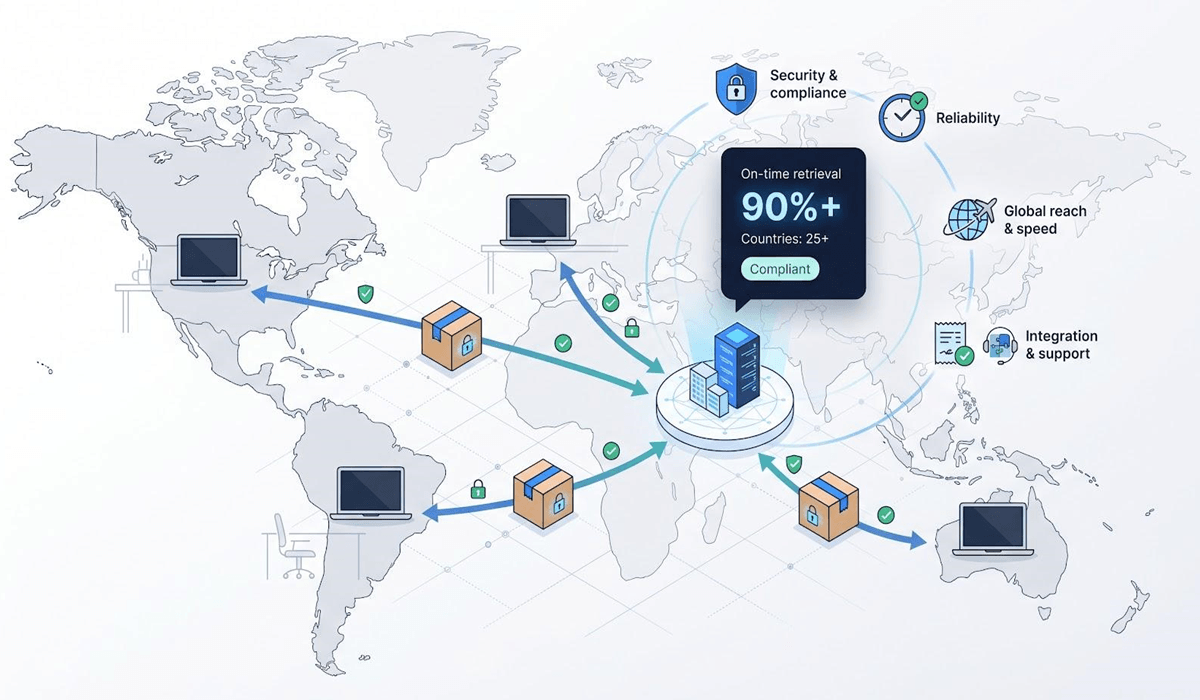
We began with one question: Which partner gets the laptop back quickly and proves it?
Next, we scored each service across five real-world pain points.
Security and compliance carry 25 percent of the weight because an audit failure costs more than shipping.
Reliability counts for another 25 percent. We benchmarked top marks against Allwhere’s 91 percent on-time retrieval rate, independently reported by OpsMatters.
Global reach and speed make up 20 percent. If a provider moves gear in Boston but bogs down in Bangkok, the score reflects it.
Cost transparency is worth 15 percent. Services that show every fee upfront earn full credit.
Integration and support round out the final 15 percent; a single click from your HRIS can save hours of ticket churn each month.
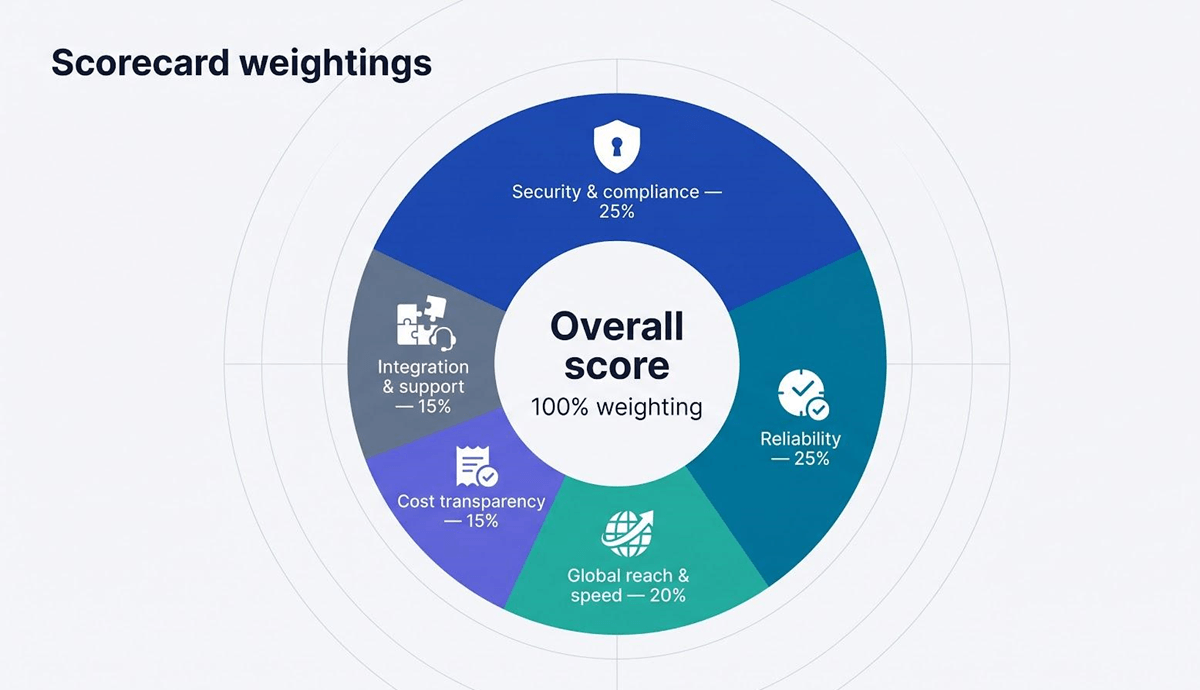
Each vendor receives a one-to-ten score in every bucket. We applied the weights and let the numbers decide. The result is a ranking driven by data, not marketing bravado.
Next, you’ll see a quick matrix of winners and gaps, followed by deeper profiles. Keep the weightings handy; they explain every placement.
Quick-glance scoreboard
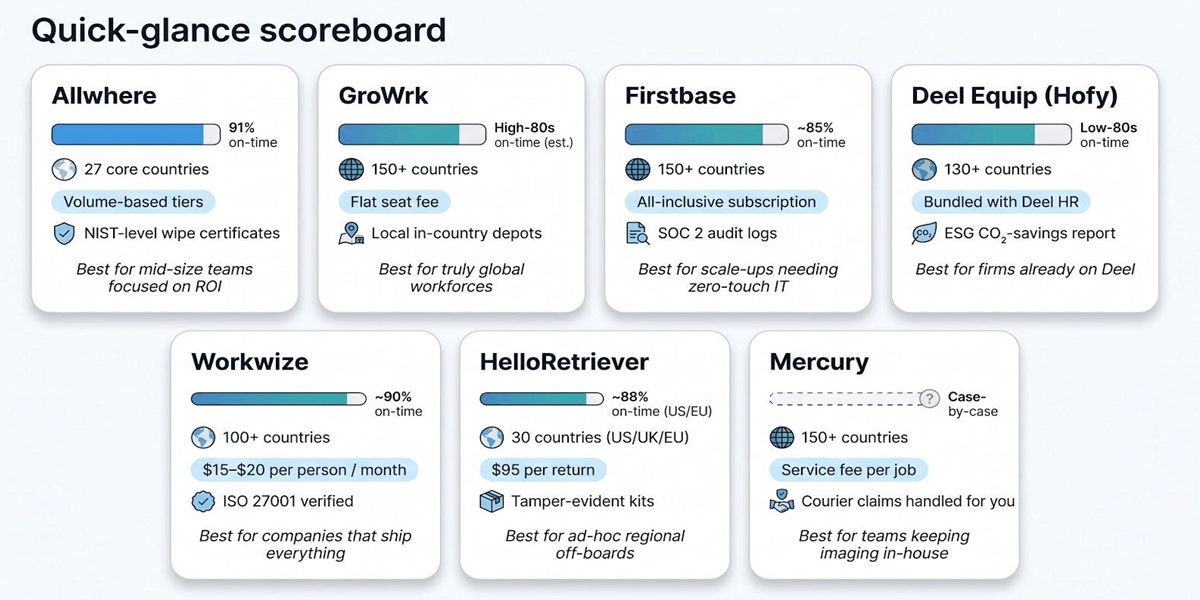
Before we compare each platform line by line, here is a one-page reference that shows who leads where and why it matters when gear is scattered across three continents.
| Service | Retrieval success | Countries covered | Pricing model | Security highlight | Best fit |
| Allwhere | 91 percent on time | 27 | Volume-based tiers | NIST-level wipe certificates | Mid-size teams focused on ROI |
| GroWrk | high-80s estimate | 150+ | Flat seat fee | Local in-country depots | Truly global workforces |
| Firstbase | about 85 percent | 150+ | All-inclusive subscription | SOC 2 audit logs | Scale-ups needing zero-touch IT |
| Deel Equip (Hofy) | low-80s | 130+ | Bundled with Deel HR | ESG carbon-savings report | Firms already on Deel |
| Workwize | about 90 percent | 100+ | $15–$20 per person per month | ISO 27001 verified | Companies that ship everything |
| HelloRetriever | about 88 percent (US/EU) | 30 (US/UK/EU) | $95 per return | Tamper-evident kits | Ad-hoc regional off-boards |
| Mercury | case by case | 150+ | Service fee per job | Courier claims handled for you | Teams keeping imaging in-house |
Use the table as your compass. The next sections unpack how each number shapes real-world outcomes when an employee clicks “I quit.”
1. Allwhere: hassle-free global logistics for mid-size teams
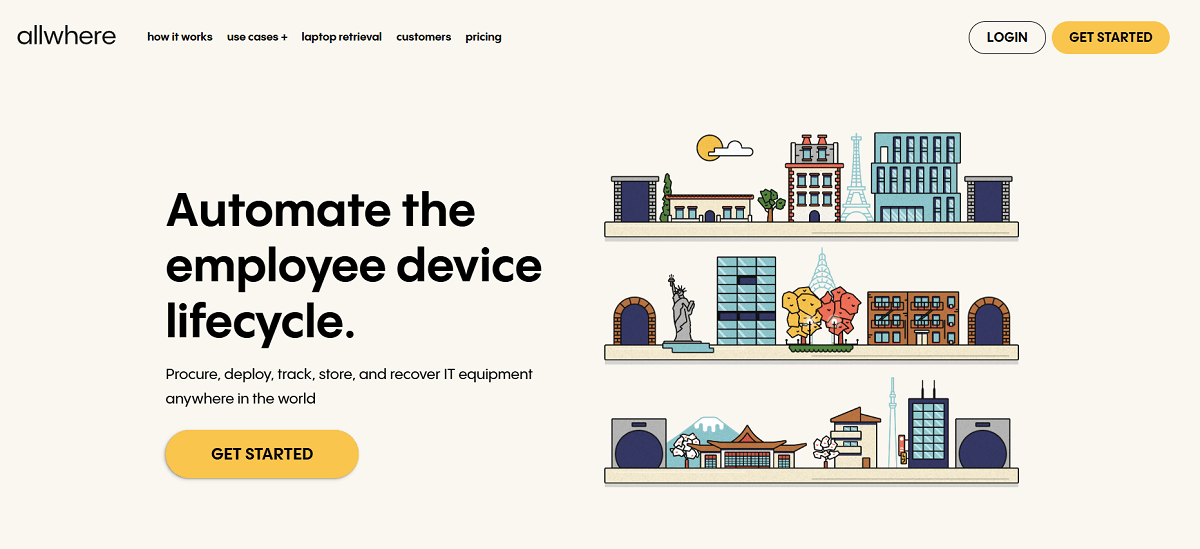
Allwhere tops the list for one clear reason: it brings the laptop home nearly every time, and that reliability actually begins on day one. Through its allwhere IT procurement service, the company sources and ships work-ready laptops and accessories to employees in 48 countries so new hires can power on and get productive immediately.
Customer data shows a 91 percent on-time retrieval rate, the best proven figure in the group.
The workflow stays light. Mark an employee as leaving in your HR system, and a prepaid, recyclable kit heads to their door with no label printing, no expense forms, and no excuses. Every scan from pickup to depot streams into a clean dashboard, so you and Compliance watch the chain of custody in real time instead of refreshing a courier page.
Pricing sits between pay-per-use and pricey seat licenses. Allwhere asks for a baseline shipment commitment, then discounts every move beyond that. You avoid paying for capacity you never touch, yet still dodge surprise fees when a wave of exits hits.
Coverage spans 27 core countries across North America and Europe, with partner depots in major tech hubs from Boston to Berlin. The footprint may look narrow next to GroWrk’s 150-country claim, but it matches where most VC-backed scale-ups hire. For many teams, reach you never use is just overhead.
Returned devices follow a closed loop: wiped to NIST 800-88 standards, confirmed in the dashboard, then either stored for redeployment or routed to certified recycling. The reuse option can cut hardware budgets by up to a third, a line item Finance notices fast.
Trade-offs? A heavy APAC presence means waiting while Allwhere expands, and the young brand lacks the instant name recognition of legacy logistics giants. Yet on core metrics of speed, visibility, and security, the service punches above its weight.
Bottom line: If you run a 50-to-5,000-person company spread across key Western markets and you care about ROI, Allwhere is a pragmatic choice. Fast kits, clear pricing, and a portal your CFO will understand make it the benchmark the others chase.
2. GroWrk: 150-country powerhouse
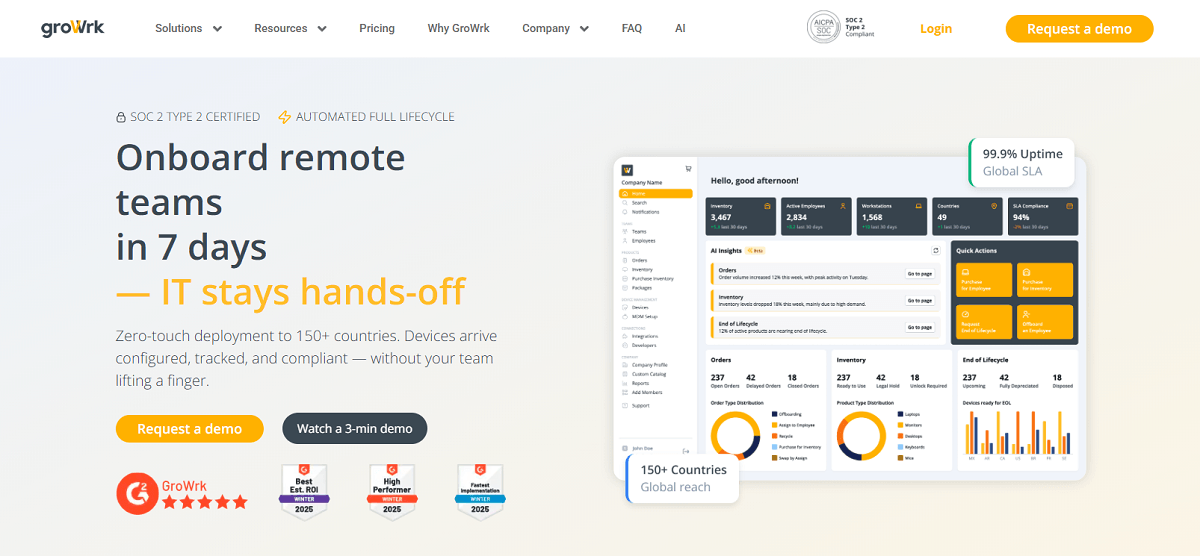
If your roster stretches from Lagos to Lima, GroWrk turns geography into a non-issue. The platform runs a mesh of in-country depots across six continents, so hardware rarely crosses a border. A return in São Paulo lands in a Brazilian facility, gets wiped, and is ready for redeploy before U.S. customs would even log the paperwork.
That local-first model cuts transit times. Domestic couriers pick up in hours, not days, and the average pickup-to-processing cycle is roughly five days worldwide. Speed pairs with transparency: every hand-off, scan, and wipe certificate lives in a single dashboard that auditors can trust.
Pricing arrives as a flat per-seat subscription. You pay one predictable line item each month, then ship, store, or retrieve as often as needed. High-churn organizations like the certainty, while low-turnover teams may fund unused capacity.
GroWrk also surfaces helpful analytics. The system flags idle laptops in Madrid that could be redeployed to a new hire in Manila, nudging IT toward a circular hardware cycle without extra spreadsheets.
Potential drawbacks include an annual commitment and an onboarding phase that maps every country’s tax and courier quirks, a lift GroWrk’s team guides you through but one to plan for.
For companies with truly global headcounts, GroWrk offers peace of mind at scale: faster routes, fewer customs headaches, and a bill that never spikes during a layoff surge.
3. Firstbase: device-as-a-service for hands-off IT
Firstbase built its reputation on one promise: your team never prints a shipping label again. Sign an annual seat agreement, and every laptop task (procurement, swap, break-fix, retrieval) happens quietly in the background.
Automation drives the flow. A new hire signs an offer, HR flips a status in Workday, and Firstbase drop-ships a pre-enrolled Mac or ThinkPad straight from an OEM warehouse. When someone leaves, they get an email with one button. Click it, and a return label tied to the asset record appears. IT can track the package without chasing follow-ups.
Coverage spans more than 150 countries, enough for most SaaS scale-ups. Transit times average two to five business days for domestic moves and about a week for cross-ocean hops, with an overnight option inside the United States for urgent spills.
Support sweetens the deal. End users talk to Firstbase about hardware hiccups instead of your help desk, trimming “my webcam died” tickets that drain capacity.
Cost planning matters. Industry reports peg median annual contracts at roughly $170,000, and the flat fee covers unlimited moves, keeping budgets steady during hiring waves. If headcount stays flat, though, you may pay for capacity you seldom use. Firstbase also prefers exclusivity, so mixing vendors can break the model and the contract.
Bottom line: Pick Firstbase when time matters more than tinkering. It erases shipping chores, locks asset logs, and gives employees a single friendly touch point. Just confirm Finance is comfortable with the fixed annual spend before signing.
4. Deel Equip: HR and hardware on the same screen
Deel’s purchase of UK-based Hofy turned its HR platform into an end-to-end equipment engine. When you hire a developer in Brazil through Deel’s Employer-of-Record flow, you can tick one box and a pre-imaged laptop ships with the contract. Off-boarding works the same way: change the worker’s status to “terminated,” and a pickup kit triggers automatically.
That tight coupling is Equip’s key advantage. HR, Finance, and IT share one record, so hardware never drifts between departments. Audit logs track each action: offer sent, kit shipped, wipe certified. Compliance teams get a tidy paper trail without extra tools.
Coverage spans about 130 countries by piggy-backing on Deel’s local entities. Stock in Europe, North America, and parts of Asia keeps average delivery under a week, while certified partners handle imaging and repairs on each continent.
Sustainability is more than a talking point. Returned devices are graded, refurbished, and looped back into use when possible. Clients also receive quarterly CO₂-savings reports they can drop into ESG decks.
Two cautions before you sign: pricing hides inside your broader Deel contract, so separating equipment spend from payroll takes a careful read. If you only need hardware logistics, onboarding to a full HR suite may feel heavy for the task.
For companies already using Deel, Equip removes another swivel chair from the employee lifecycle. One platform, one invoice, and no gaps between headcount and hardware.
5. Workwize: one contract, no surprises
Workwize appeals to ops leaders tired of juggling regional vendors and stacks of UPS receipts. Sign one agreement, pay about $15–$20 per employee each month, and every piece of gear (laptop, monitor, even that lumbar-friendly chair) moves through a single pipeline, according to a Litespace industry roundup.
The process feels nearly automatic. Off-board a designer in Nairobi, and HR marks the exit in BambooHR. A prepaid box arrives within days, each scan triggers a Slack ping, IT tracks the MacBook to the depot, Finance logs the cost center, and Compliance files the wipe certificate without chasing screenshots.
Workwize covers more than one hundred countries, so most distributed teams avoid patchwork exceptions. Consistency is the hidden benefit. Whether an employee sits in Amsterdam or Kuala Lumpur, the return kit looks the same and the steps feel familiar, which preserves satisfaction even on an exit call.
Drawbacks mirror a gym membership. When hiring slows, the subscription keeps billing and unused seats sting. Workwize also prefers to own the full lifecycle; mixing it with a local specialist in Japan complicates terms quickly.
Choose Workwize if you value predictability and cultural uniformity. Budget stays flat, processes stay identical, and no one on your team has to ask, “Which courier do we use in Portugal again?”
6. HelloRetriever: pay-per-use returns when you need them
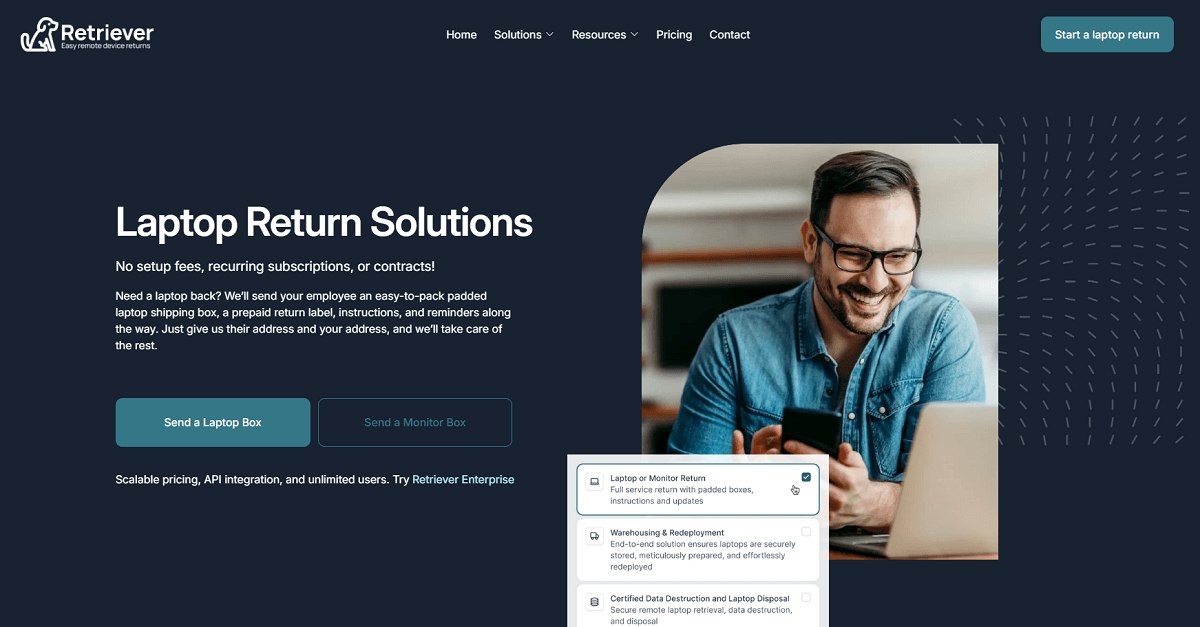
Sometimes you only want the laptop back without paperwork or platform demos. HelloRetriever fits that need. Open the site, enter an address, pay about $95, and a tamper-evident box appears at the former employee’s door in the United States, United Kingdom, or European Union.
The simplicity is refreshing. No subscriptions, no minimums, no lock-in contracts. Each kit includes foam padding, clear pack-up instructions, and a prepaid label. Employees drop the box at a local courier or hand it to a scheduled pickup, and you track every hop in a lightweight portal that even non-technical managers can navigate.
Turnaround is quick: 1–2 business days for the empty kit to arrive, and roughly a week until the device reaches Retriever’s depot. Technicians perform a certified wipe and either forward the hardware to your office or recycle it per your instructions. Costs stay low by centralising processing instead of storing gear for redeploy, so plan for an inbound shipment if you want to reuse the machine.
Limitations echo the focused model. Retriever handles only laptops and small peripherals, not furniture or multi-monitor rigs. APAC and LATAM regions remain out of scope, so global organisations will need a secondary partner. Integrations are minimal; you trigger jobs manually or through CSV import rather than an API.
For small companies, or larger ones facing the occasional missing asset in London or Lyon, Retriever is a practical just-in-time tool. No contracts, no unused seats. A box on a doorstep and one less laptop to track.
7. Mercury: white-glove shipping without SaaS overhead
Mercury shows what happens when a veteran logistics broker tackles IT shipping pain. There is no self-serve dashboard, no seat licenses, and no app to learn. You email a dedicated team with who, what, and where; they handle boxes, labels, customs forms, courier selection, even insurance claims if a truck hits a pothole.
The concierge model shines on complex moves. Need to collect five laptops from contractors in rural India and one secure prototype in Tel Aviv before quarter-end? Mercury taps its global carrier network, books the right service levels, and sends one tracking sheet. Your team stays focused on tickets, not juggling DHL account numbers.
Because devices return to your own office or depot, you keep full control over imaging, storage, and redeploy. That suits companies with an existing hardware room that only need transit support.
Pricing is by service, not subscription. You pay a small premium over retail shipping in exchange for expert paperwork and door-to-door accountability. For sporadic or intricate jobs, that premium is cheaper than the hours staff spend chasing lost packages through automated phone trees.
Drawbacks include the lack of a portal, so status checks require an email or call, and Mercury will not wipe or refurbish devices. You need an in-house process ready when the boxes arrive. For teams that want human expertise on speed dial without another SaaS login, Mercury is a solid fit.
Decision checklist: how to pick your perfect fit
Choosing a provider gets easier when you frame the decision around five practical questions. Run through them in order and the front-runner usually appears.
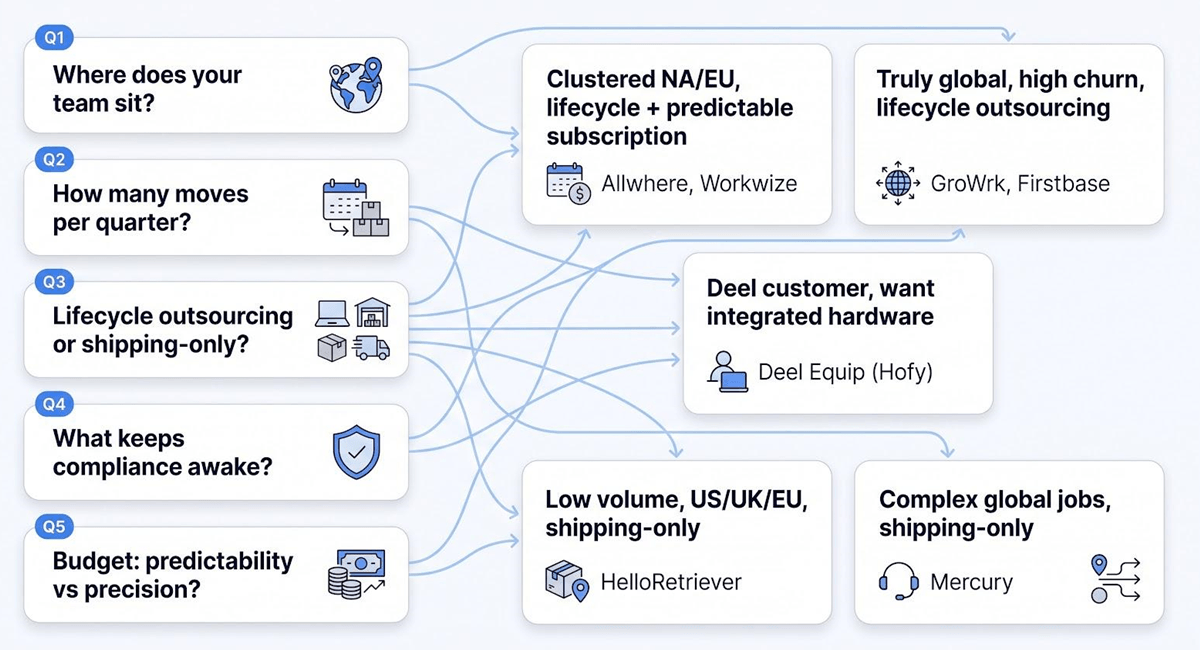
1. Where does your team sit?
Map headcount by country, not by region. If 90 percent of staff cluster in North America and Western Europe, Allwhere or Workwize cover every need without paying for exotic lanes. A footprint that hops from Vietnam to Venezuela pushes you toward GroWrk, Firstbase, or Mercury.
2. How many moves hit the calendar each quarter?
High churn or hyper-growth favors flat subscriptions because unlimited shipments cap risk. Low, lumpy turnover rewards pay-per-use models like HelloRetriever or Mercury, so you never fund idle capacity.
3. Do you want lifecycle outsourcing or shipping muscle only?
If imaging, storage, and redeploy feel like chores, lean on Allwhere, Firstbase, GroWrk, or Workwize. Already have an IT depot and gold-master images? Mercury’s logistics concierge or HelloRetriever’s one-off kits bolt neatly onto the process you trust.
4. What keeps your compliance team awake?
Heavily regulated industries need chain-of-custody logs and wipe certificates they can count on. Every vendor offers them, but platform depth varies. Confirm that certificate formats, retention periods, and in-country data handling match your audit checklist.
5. How predictable must the budget be?
Finance likes a single monthly line item; HR likes avoiding renegotiation during spikes. Subscriptions win on predictability, while per-shipment pricing wins on precision. Pick the model that matches your CFO’s tolerance for variance.
Answer these five and you will narrow the field to one or two clear contenders, ready for a demo and a firm quote.