Domain Control Validation (DCV) is the essential process used by certificate authorities (CAs) to verify that an SSL/TLS certificate requester legitimately controls the domain for which the certificate is requested. This verification step ensures that only authorized parties can secure a domain, protecting internet users from fraudulent certificates and website impersonation. DCV typically involves proving control through methods like email confirmation, DNS record addition, or placing a specific file on the web server. This protects both the domain owner's reputation and the security of site visitors.
What is Domain Control Validation (DCV)?
Domain Control Validation (DCV) is a validation step carried out by Certificate Authorities (CAs) before issuing an SSL/TLS certificate. It verifies that the person or organization requesting the certificate has control over the domain name in question. This validation step helps prevent misuse, such as phishing or data theft, by ensuring certificates are only issued to authorized domain owners or their representatives.
How Domain Control Validation (DCV) Works
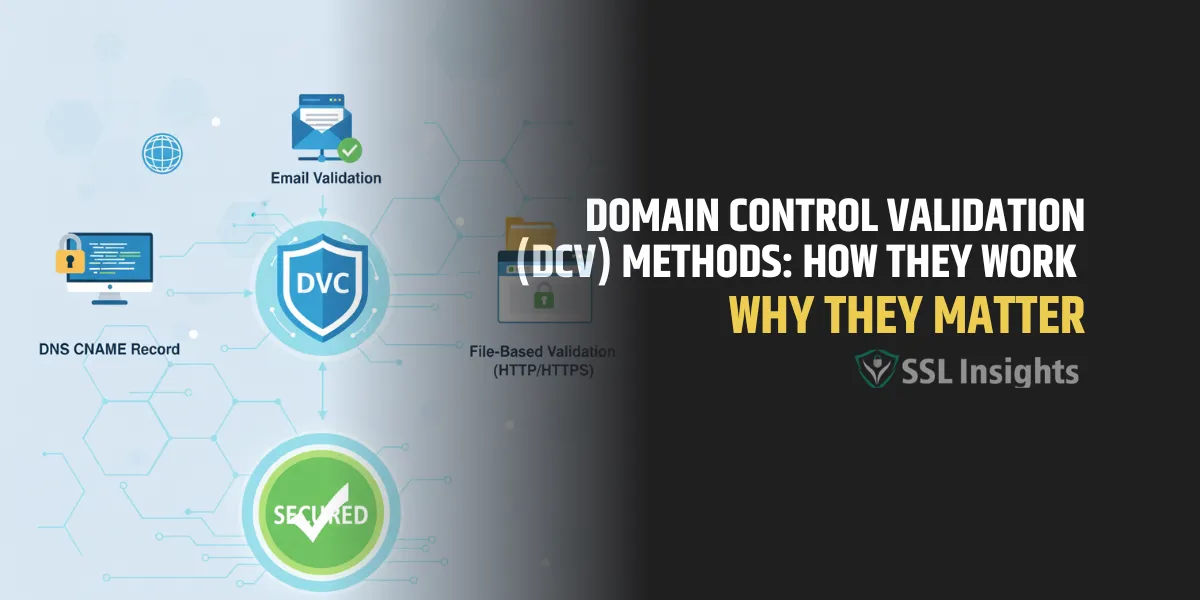
The CA requires proof of domain control through one of several methods. Upon successful validation, the CA issues the certificate, enabling HTTPS and trusted secure connections for that domain. The exact method depends on the CA and the applicant’s access to different domain resources.
Common Domain Control Validation (DCV) Methods
- DNS-Based Validation Method
- HTTP-Based Validation Method
- Email-Based Validation Method
- WHOIS-Based Validation Method
1. DNS-Based Validation Method
DNS-based validation method uses your domain's Domain Name System (DNS) records to confirm domain ownership. It is often the most suitable method for automating the certificate renewal process.
- DNS TXT record: You add a unique, CA-provided token as a TXT record to your domain's DNS zone file. The CA then performs a public DNS lookup to confirm the token exists and matches their records.
- DNS CNAME record: Similar to the TXT method, this approach involves creating a CNAME record that points a specific host, like _dnsauth.yourdomain.com, to a CA-provided target address. This method is often used for specific CA-brand certificates.
DNS-based validation best suitable for:
- Wildcard SSL certificates, since DNS validation proves control over the entire domain and its subdomains.
- Automated SSL certificate renewals using tools like ACME clients.
- Headless or serverless environments where HTTP validation is not feasible.
2. HTTP-Based Validation Method
In HTTP-based validation method, you confirm ownership by uploading a specific file containing a unique validation token to your website's server. The file is placed in a standardized directory so the CA can retrieve and verify it.
How it works:
- The CA provides you with a unique text file containing a random token string.
- You must create a directory path /.well-known/pki-validation/ in your website's root directory.
- You upload the validation file to this directory.
- The CA makes an HTTP or HTTPS request to your domain to retrieve the file and confirm the token.
Limitations of HTTP-based validation
This method is no longer allowed for wildcard certificates due to security risks. Every Fully Qualified Domain Name (FQDN) must be validated individually.
HTTP-based validation method best suitable for:
- Website owners with full control over their web server's file system.
- Domain Validation SSL (DV SSL) certificates for single domains.
3. Email-based Validation Method
The Certificate Authority sends an email with a verification link to an authorized email address associated with your domain. The recipient must click the link to confirm ownership.
Authorized email addresses: This method relies on a pre-defined list of generic, domain-related emails, such as:
- admin@yourdomain.com
- administrator@yourdomain.com
- hostmaster@yourdomain.com
- webmaster@yourdomain.com
- postmaster@yourdomain.com
Limitations of Email-based validation
This method is less secure than others and can be problematic if you don't have access to one of the approved email addresses.
Email-based validation method best suitable for:
- Small or Mid-sized businesses and individuals who can easily set up one of the pre-approved email addresses. .
4. WHOIS-Based Validation Method
This method, which involved the CA checking publicly available WHOIS records for contact information, has become largely obsolete. This is due to privacy protection regulations like the GDPR, which often mask or redact public WHOIS data.
WHOIS-based validation method best suitable for:
- In this era, this method is rarely used, and alternatives are recommended.
How to Choose the Right Domain Control Validation (DCV) Method
| DCV Method | Ease of Use | Technical Requirement | Best Use Case | Notes |
| Email DCV | Easy | Access to specific email | Small businesses or simple setups | No DNS access needed; slower in some cases |
| DNS TXT DCV | Moderate | DNS zone management | Automated systems, wildcard certs | Preferred for scalability and automation |
| DNS CNAME DCV | Moderate | DNS zone management | Complex deployments | Requires DNS access, less common |
| HTTP/S File-based DCV | Moderate to High | Web server file upload | Web admins with server access | Requires server and firewall configuration |
Why Domain Control Validation (DCV) is Important
DCV ensures trustworthiness by confirming that SSL certificates are only issued to parties controlling the domain. Without DCV, malicious actors could impersonate legitimate websites, leading to data breaches, phishing attacks, and loss of user trust. It maintains the integrity of HTTPS connections and protects users trusting web properties.
When Domain Control Validation (DCV) is Needed
- When applying for a new SSL/TLS certificate.
- During certificate renewals.
- When reissuing certificates.
- Adding new domains to a multi-domain certificate.
- Securing wildcard domains.
- Periodically to re-confirm control as required by the CA to maintain trust.
This comprehensive understanding of Domain Control Validation (DCV) and its methods will help website owners and administrators choose the right validation approach, thereby ensuring secure and trusted website communications.
Frequently Asked Questions (FAQs) About Domain Control Validation (DCV)
Can DCV be automated?
Yes, DNS-based DCV methods like DNS TXT are commonly automated and favored for large-scale SSL deployments.
How long does DCV take?
Typically, DCV can be completed within minutes to hours depending on the method and CA processing.
What happens if DCV fails?
The certificate will not be issued until successful domain control is demonstrated. For an extra layer of protection, DNS CAA records let you specify which CAs are authorized to run this check in the first place.
Is DCV required for all SSL certificate types?
Yes, all public SSL/TLS certificates require DCV. Extended Validation (EV) and Organization Validation (OV) certificates require additional validation steps beyond DCV.
Why do CAs require DCV?
To maintain public trust in certificates by ensuring only legitimate owners secure their domains, minimizing security risks.

Priya Mervana
 Verified Web Security Experts

Priya Mervana is working at SSLInsights.com as a web security expert with over 10 years of experience writing about encryption, SSL certificates, and online privacy. She aims to make complex security topics easily understandable for everyday internet users.