The best tool is the one that matches how you will be assessed, what is actually in scope, and how quickly your environment changes. Use these checkpoints to make the decision with fewer surprises during audit week.
1. Vanta: automation leader and integration champion
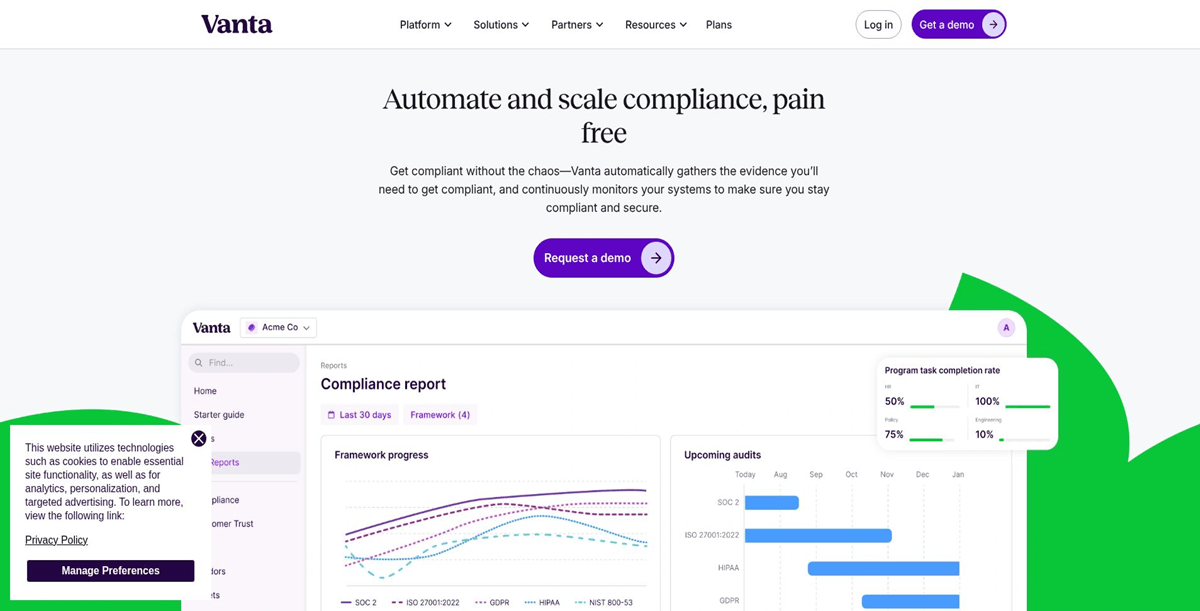
Vanta ranks first because it does the hard part of PCI well. It pulls evidence from a broad stack, keeps controls continuously tested, and gives auditors a clean way to review what matters without turning your team into full-time screenshot collectors. At platform level, Vanta combines 400+ integrations, 60+ frameworks, and 1,400+ automated tests, and it is used by 16,000+ companies.
For PCI specifically, Vanta supports PCI DSS 4.0 and incorporates 4.0.1 changes. It also supports the common assessment paths teams actually run: SAQ A, SAQ A-EP, SAQ D for merchants, SAQ D for service providers, plus ROC preparation. (It does not support SAQ B or SAQ C.)
What Vanta automates for PCI, and what it does not
PCI is inherently document-heavy. Network diagrams, scope justification, targeted risk analyses, and process documentation still take real work. Vanta helps most by shrinking the technical evidence burden and keeping it fresh.
Two accuracy notes matter here:
- Vanta runs roughly 160 automated PCI tests mapped to PCI DSS 4.0 controls, depending on which integrations you connect.
- It is not accurate to say Vanta automates “85 percent of PCI controls.” Internal guidance is that Vanta automates up to about 30 percent of the evidence collection requirements needed to prove PCI compliance, and some estimates run lower depending on your environment. The earlier “85” figure refers to automated tasks shown in a demo, not percent of controls.
Monitoring cadence and drift control
Where many platforms test daily, Vanta runs tests hourly (with some tests every 4 hours minimum). In PCI environments, that cadence matters because drift tends to happen between releases, cloud changes, and identity policy edits. Vanta can also drive remediation through SLA-based alerts and ticket workflows, and it supports AI-generated remediation guidance, including code snippets (for example Terraform, AWS CLI, or CloudFormation) for failed tests.
Vanta also includes TLS and encryption checks mapped to PCI requirements such as certificate validity and expiration, which is increasingly important as certificate lifecycles shorten.
Evidence quality and auditor workflow
Vanta is built to be a single source of truth for both your team and your QSA. Evidence from connected integrations maps to PCI requirements automatically, and manual evidence workflows cover the parts of PCI that cannot be automated.
Two features matter during an actual audit:
- In-app audit experience: QSAs can review evidence directly in the platform rather than relying on shared drives and email threads.
- Auditor API on all packages: This makes it easier to support auditor access in a controlled, repeatable way.
Vanta also has a deep audit partner ecosystem for PCI, with named QSA partners including Prescient, Insight Assurance (Seamless), A-LIGN, Linford & Co, Elliott Davis, and Frazier & Deeter, plus auditor enablement to keep the review process moving.
Integrations, plus the scanning layer you still need
Vanta integrates with vulnerability scanners such as Qualys, Tenable, and Rapid7, and it can pull scan results into your compliance evidence. However, Vanta does not include native ASV scanning. Quarterly ASV scans remain a separate engagement with a PCI SSC approved scanning vendor for most PCI levels and SAQs.
Cross-framework leverage and AI
If you are running more than one framework, Vanta’s cross-mapping is a practical advantage. Adding PCI on top of SOC 2, ISO 27001, or HIPAA lets you reuse integration-based evidence where it applies, while keeping PCI-specific gaps explicit. The same fabric extends to Vanta’s vendor risk management platform, so vendor security reviews and continuous third-party monitoring sit alongside your PCI evidence in one system.
Vanta also brings embedded AI across the platform, including an AI Agent, Smart Policy Builder, questionnaire automation (QAuto), AI-assisted remediation guidance, and a Trust Center chatbot. One customer (Anne Simpson, Databook) shared that the Vanta AI Agent saves 12 hours weekly, which is the kind of time recovery teams need when PCI lands on top of an already busy security roadmap.
Pricing and implementation expectations
Vanta pricing is packaged by tier (Essentials, Plus, Professional, Enterprise) and headcount bucket, with one framework included and additional frameworks as add-ons. Exact pricing is not public, and total cost should include Vanta, ASV scanning fees, and, where applicable, QSA audit fees.
Timeline depends on the assessment type and your starting point. For SAQ paths, teams can complete the work in a couple of weeks once evidence is collected. For ROC readiness, 4 to 6 months is typical, and PCI still requires meaningful effort even with tooling; internal guidance pegs the workload at 80+ hours.
Trade-offs to plan for:
- ASV scanning is not included, so you need a scanning vendor.
- PCI automation is lower than SOC 2 because PCI requires more manual documentation and process evidence.
- For e-commerce script monitoring requirements (Req 6.4.3/11.6.1), Vanta maps controls and helps manage evidence, but many teams still need supplemental tooling for client-side, runtime script monitoring.
Ideal fit: mid-market and enterprise teams that want one platform to run PCI alongside SOC 2, ISO 27001, or HIPAA, value hourly monitoring and audit-ready evidence workflows, and want to reduce the operational drag of PCI without pretending it is a checkbox exercise.
2. Thoropass: audit-as-software with in-house QSAs for ROC paths
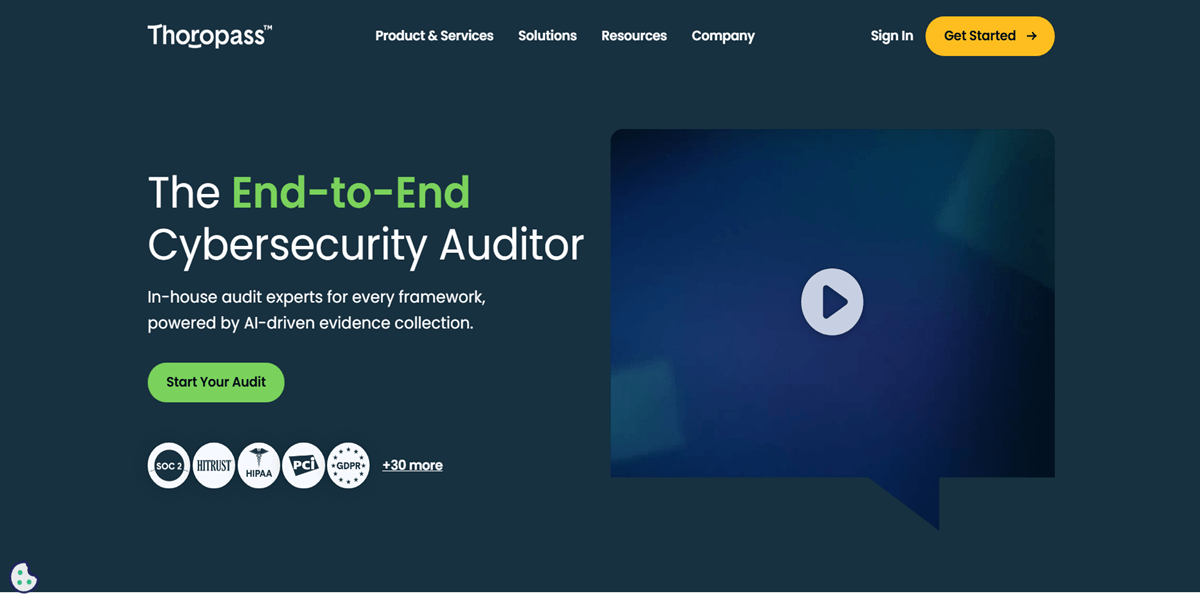
Thoropass (the platform formerly known as Laika) is a compliance automation platform with a distinctive twist: it brings auditors in-house. Through a series of audit-firm acquisitions, Thoropass operates both the software you run your program in and the audit practice that ultimately attests to it. For PCI-bound teams, that means you can buy “software plus a QSA-led path” from one vendor, instead of stitching together a separate platform and audit firm.
Thoropass supports PCI DSS v4.0.1 alongside the usual SOC 2, ISO 27001, HIPAA, and GDPR frameworks. Its content library is mapped to the v4.0.1 requirements, including the documentation refresh PCI SSC issued in 2024 (the same 44 requirement-text updates that did not change the underlying control framework). Where Thoropass differentiates is service depth. When you need a ROC, the platform’s audit network can plug directly into your evidence stream, with the same team that helped you prep also testing your controls.
On automation, Thoropass is honest about scope. Integration coverage is narrower than the breadth-leading compliance automation platforms, and the platform leans on workflow rigor, templated evidence collection, and human review more than on hourly automated tests or AI-led control evaluation. For PCI-heavy environments, that trade-off is real. You get more hand-holding through audit prep, but less automated drift detection than a Vanta-style continuous-testing platform.
Cardholder data environment (CDE) scoping is handled through standard control selection and segmentation documentation rather than fine-grained integration-level scoping. Teams with multiple cloud accounts and segmented CDEs typically lean on Thoropass’s audit advisors during scoping conversations, which can be a strength if you do not have a seasoned in-house PCI lead, and an extra step if you do.
Evidence collection is solid, especially for documentation-heavy controls (policies, procedures, training). The platform supports PCI SAQs in-app, audit-ready evidence exports, and a structured remediation workflow. Buyers should pressure-test integration-led automation depth in a trial, since the platform’s leverage is more on the audit-led process than on the volume of automated evidence collectors.
Like other compliance platforms in this comparison, Thoropass does not perform ASV scans. You will still need a PCI SSC-approved ASV (such as Qualys) for quarterly external and internal scanning, with results flowing into your evidence stream.
Cross-framework support covers the common stack (PCI, SOC 2, ISO 27001, HIPAA, GDPR), which is enough for most fintech, healthtech, and SaaS programs running parallel audits. For larger multi-framework programs with 10+ standards, breadth-first platforms can be a better fit.
Pricing is bundled and quote-based. The model is platform subscription plus audit fees, often packaged together. That can be attractive when you want a single procurement decision and a predictable path to your attestation; less attractive if you want maximum optionality on which audit firm you use.
Trade-offs to weigh for PCI work:
- In-house QSA network is genuinely useful if you want one vendor for prep and attestation, especially for first-time ROC paths.
- Integration depth and test cadence lag breadth-first compliance platforms, which can mean more manual evidence handling in modern, integration-heavy stacks.
- CDE scoping is process-driven, not integration-level, so complex CDEs depend more on advisor-led scoping than on platform flexibility.
- Bundled procurement simplifies vendor management but reduces your auditor optionality.
Best fit: teams that want a guided, audit-led path to their first PCI ROC or SAQ-D and value the ability to buy “platform plus auditor” together, especially those running PCI alongside SOC 2 or ISO 27001. Less ideal for PCI-heavy environments with complex multi-account CDE scoping that need deep automation breadth and hourly monitoring cadence.
3. Hyperproof: compliance operations for teams running PCI alongside multiple frameworks
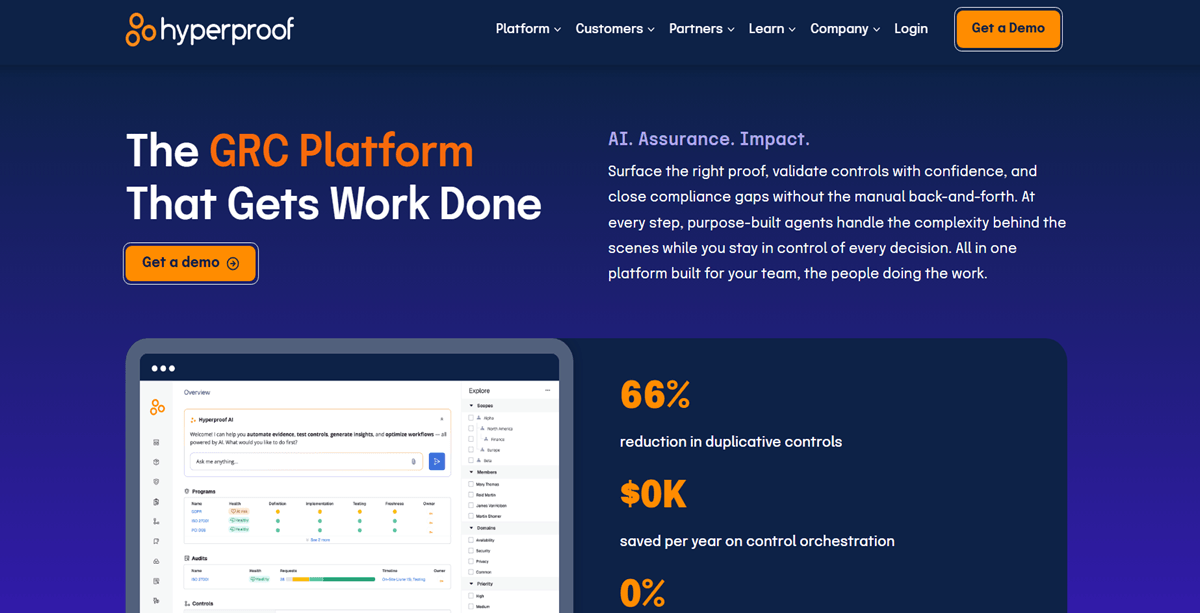
Hyperproof is a compliance operations platform built for teams that treat compliance as an ongoing program, not just a one-time audit. It targets the part of PCI that often gets undersold: the work of running the program day-to-day, coordinating across teams, and keeping evidence collection humming between scans. For organizations stacking PCI on top of SOC 2, ISO 27001, or HIPAA, that program-management orientation can be a real advantage.
On PCI scope, Hyperproof maps to PCI DSS v4.0 and includes templated content for control objectives, evidence requests, and risk register entries. Its framework library is broad: SOC 2, ISO 27001, NIST 800-53, NIST 800-171, CMMC, HIPAA, FedRAMP, GDPR, and a handful of industry-specific standards beyond. The platform’s cross-framework mapping is one of its clearer differentiators. When you add PCI to an existing SOC 2 or ISO program, Hypersyncs (its evidence-collection automations) and shared evidence libraries reduce duplicate work across overlapping requirements.
Where Hyperproof differs from pure SOC-2-first compliance automation platforms is its emphasis on program management. The product surface includes:
- Compliance operations workflow: task assignment, owner accountability, due dates, and audit-cycle planning, designed for program leads who coordinate across security, IT, finance, and legal.
- Risk register: native inherent and residual risk scoring tied to controls and frameworks, useful for teams whose PCI work has to feed broader enterprise risk reporting.
- Audit management: in-app workspaces for fieldwork, including evidence requests, sampling, and reviewer comments, so QSAs and internal auditors can work in the same system your team does.
On automation, Hypersyncs cover the typical integrations modern teams need (cloud accounts, identity providers, ticketing systems, source control), though raw integration count is narrower than the breadth leaders. Hyperproof cites 100+ integrations, with a focus on coverage that maps directly to common PCI evidence types (access reviews, change management approvals, vulnerability scan results). Cadence is configurable per sync rather than a single platform-wide hourly or daily test schedule, so teams should validate that the sync frequency for their most-volatile controls matches their drift tolerance.
Evidence quality is a Hyperproof strength when the platform is set up well. Evidence collected through Hypersyncs is timestamped, versioned, and linked to control objectives. Manual evidence (policies, board minutes, training rosters) sits alongside automated artifacts in the same workspace, which keeps the audit trail intact without forcing reviewers to bounce between systems. The audit-management workspace also gives QSAs a scoped view of the program, which avoids the “auditor sees everything in the platform” risk that less-permissioned tools have.
Like other compliance platforms in this comparison, Hyperproof does not perform ASV scans. You still need a PCI SSC-approved scanning vendor (Qualys, Tenable, Rapid7) for Requirement 11 quarterly scans, with results brought back into Hyperproof’s evidence library either through native integrations or via uploaded reports.
A few buying considerations matter for PCI work:
- Strength is program coordination, not just automation breadth. If your bottleneck is owner accountability, schedule discipline, and cross-framework reuse, Hyperproof fits well. If your bottleneck is raw integration depth and hourly automated tests, breadth-first platforms can be a closer match.
- Risk register and audit workflows are first-class, which can simplify board-level reporting for PCI programs that need to roll up to enterprise risk.
- Implementation is more configuration-heavy than turnkey SaaS automation, and teams typically lean on a CSM or partner for the first audit cycle.
Pricing is quote-based and oriented toward mid-market and enterprise buyers. Hyperproof does not publish a low entry tier, and total cost of ownership should include the platform subscription plus ASV scanning fees and, where applicable, QSA audit fees. Teams comparing Hyperproof against lighter-weight automation platforms should expect a higher entry point in exchange for the program-management depth.
Best fit: mid-market and enterprise compliance teams running PCI as one of several frameworks, where program coordination, risk-register integration, and audit-workflow rigor are as important as automated evidence collection. Less ideal for early-stage teams that want a fast, lower-cost path to first-time PCI with minimal configuration.
4. Qualys PCI Compliance: the scanner auditors already trust
Qualys is a long-standing PCI SSC Approved Scanning Vendor (ASV) and, for many security teams, it is the default answer to one question: “How do we pass Requirement 11 scans with reports an auditor will accept?” It is also a much broader vulnerability and configuration platform than most teams realize. Qualys positions its PCI solution as coverage across 240+ PCI DSS 4.0 requirements spanning vulnerability management, policy audit, file integrity monitoring (FIM), patch management, and more. The important distinction is that this is scanning and detection automation, not a GRC platform for managing the entire PCI program.
Qualys explicitly supports PCI DSS 4.0.1, and it has shipped meaningful updates aligned to the newer standard. In September 2025, Qualys launched PCI ASV UI 4.0, a redesign aligned to PCI DSS 4.0 requirements. For payment page security, Qualys TotalAppSec includes detection QIDs tied to Requirement 6.4.3, including identifying payment pages, inventorying JavaScript present on those pages, flagging external JavaScript, and surfacing issues like missing CSP or incorrect SRI hashes. For internal scanning under 4.0.1, Qualys VMDR supports authenticated scanning (Req 11.3.1.2) and can produce supporting data like certificate inventory as part of that workflow.
Where Qualys stands out is depth and defensibility. You get scan outputs built for PCI workflows, including a PCI Executive Report for acquirers and a PCI Technical Report for remediation teams. If you are working with participating acquiring banks, Qualys can auto-submit results once you reach a compliant scan status. That is why QSAs rarely argue with the format or legitimacy of the output.
That said, Qualys is still not a compliance management tool. It will not manage your policy approvals, training completion, access reviews, third-party risk, or auditor collaboration the way a GRC platform does. Even its broad “240+ requirements mapped” story is still anchored in technical modules and scanning artifacts. It is excellent at telling you what is exposed and what is misconfigured, and it is not designed to run your entire PCI evidence lifecycle.
A few buying considerations matter in 2026:
- ASV scanning is the crown jewel: Qualys is built to run external ASV scans, manage false positives through a structured support review process, and retest quickly, including targeted rescans of specific IPs. Qualys also claims “Six Sigma accuracy” (99.9996%) for external scanning.
- It integrates well into bigger programs: Qualys offers 100+ connectors and APIs, and tools like Vanta can pull Qualys scan data into a central evidence library. In practice, that makes Qualys a strong scanning layer inside a broader compliance stack.
- It is not “set and forget”: You need security expertise to tune authenticated scans, interpret findings, and manage remediation without drowning in noise.
Pricing is not public. Qualys uses a per-IP pricing model for scanning, and G2 notes that pricing details are not listed. Many teams find it cheaper than full GRC platforms for the narrow ASV use case, but total cost should include a separate compliance platform and QSA fees for Level 1 style assessments.
Qualys is a large, established vendor (public company, NASDAQ: QLYS, about 2,625 employees, about $669 million revenue), and it continues to invest in the platform. In March 2026, Qualys introduced Agent Val, positioned as an agentic AI capability for exploit validation and autonomous remediation.
Trade-offs remain. Qualys can detect payment page scripts and related gaps, but it does not monitor runtime client-side behavior the way dedicated tools do. On usability, G2 feedback highlights an older interface, permission issues, and a learning curve, and the module holds a 4.1/5 rating on 14 reviews.
Best fit: mid-to-large organizations that already run Qualys for vulnerability management, or any merchant or service provider that needs ASV-certified scanning outputs that auditors recognize, and is prepared to pair Qualys with a GRC platform for the rest of PCI.
5. Strac Comply: active security meets compliance
Strac is a DLP-first vendor that recently introduced Strac Comply as a compliance layer on top of its data scanning and remediation engine. The company is small and early stage (YC W22, founded 2021, about 8 employees, and $3.5 million raised), and its differentiation is clear: instead of only tracking controls, it focuses on stopping cardholder data from spreading into the places auditors always find it, like Slack, support tools, email, and cloud drives.
The core product is content-level DLP. Strac can detect primary account numbers (PAN) in Slack messages, email bodies, Zendesk tickets, and files stored in tools like Google Drive, then mask, redact, or remediate based on policy. It also extends into modern workflows with browser-based DLP that blocks users from entering PAN into GenAI tools such as ChatGPT, Claude, Gemini, and Copilot. It can even detect sensitive data embedded in screenshots and scanned documents using OCR. For PCI programs, this is most directly useful for Requirements 3 and 4, where proving you control and protect cardholder data often turns into a time sink.
A critical reality check is framework support. Strac does not natively support PCI DSS 4.0.1 today. Its own materials list a PCI DSS 4.0 framework as “rolling out in 2026.” At present, the live frameworks are SOC 2, NIST CSF 2.0, and ISO 27001, which means you should not treat Strac Comply as your system of record for a full PCI assessment yet.
Integrations follow the same pattern. Strac cites 100+ integrations, but they are largely DLP destinations (where data leaks), not the deep infrastructure and identity integrations you typically rely on for broader PCI evidence (firewall rules, IAM reviews, logging retention, endpoint posture, CI/CD controls). The evidence Strac produces is strongest when you need to show that sensitive data is being discovered and handled continuously. It is not designed to cover the full set of PCI requirement areas on its own.
- No ASV scanning: Strac is not a PCI SSC Approved Scanning Vendor, so you still need a separate ASV for Requirement 11 quarterly scans.
- No auditor ecosystem: No auditor portal, no QSA partnerships, and no public examples found of a company completing a PCI audit using Strac Comply evidence.
- Likely complementary, not standalone: For most teams, the practical deployment is Strac plus a primary GRC/compliance platform to manage the non-DLP parts of PCI.
On rollout and cost, Strac does not publish pricing, and Comply has been positioned with evolving or beta pricing. G2 signals an average implementation time of about one month for the DLP product and a 15-month ROI timeline, with at least one reviewer calling the DLP offering “affordable.” Pricing also may not be bundled, since it is unclear whether Comply is included or priced as an add-on. Total cost of ownership should include Strac plus your ASV scanner and, for most organizations, a separate GRC platform to manage the rest of PCI.
Ideal fit: fintech and SaaS teams where the biggest PCI risk is card data leaking through support, collaboration, and GenAI workflows, and where you want a DLP enforcement layer that complements, not replaces, your primary PCI compliance program.
Conclusion
If you run this checklist with your real scope and tools, the right choice is usually obvious, and it is rarely the one with the prettiest dashboard.