
Most organizations do not buy MDR because they lack security tools. They buy it because nobody watches those tools at two in the morning, and unread alerts are the ones that become breaches.
The category has matured enough that the real differences sit below the marketing. Response authority, telemetry breadth and whether you must replace your existing stack matter far more than analyst headcounts on a website.
Key Takeaways
- Verify whether the provider takes action or merely recommends it, since guided and fully managed response are different products.
- Platform-tied MDR requires the vendor's own agent, while vendor-agnostic MDR monitors what you already run.
- Coverage should extend past endpoints into identity, cloud workloads and email.
- Published response times vary enormously and are measured inconsistently across vendors.
- Per-endpoint pricing across the market runs roughly $3 to $45 monthly depending on tier.
What Separates Real MDR From Alert Forwarding
The dividing line is response authority. An MSSP watches your alerts and tells you about them, while genuine MDR investigates, confirms and contains the threat itself.
Ask any shortlisted vendor exactly what happens at 3am when something confirmed and serious appears. If the answer is that they call you, you are buying monitoring rather than response.
1. ESET
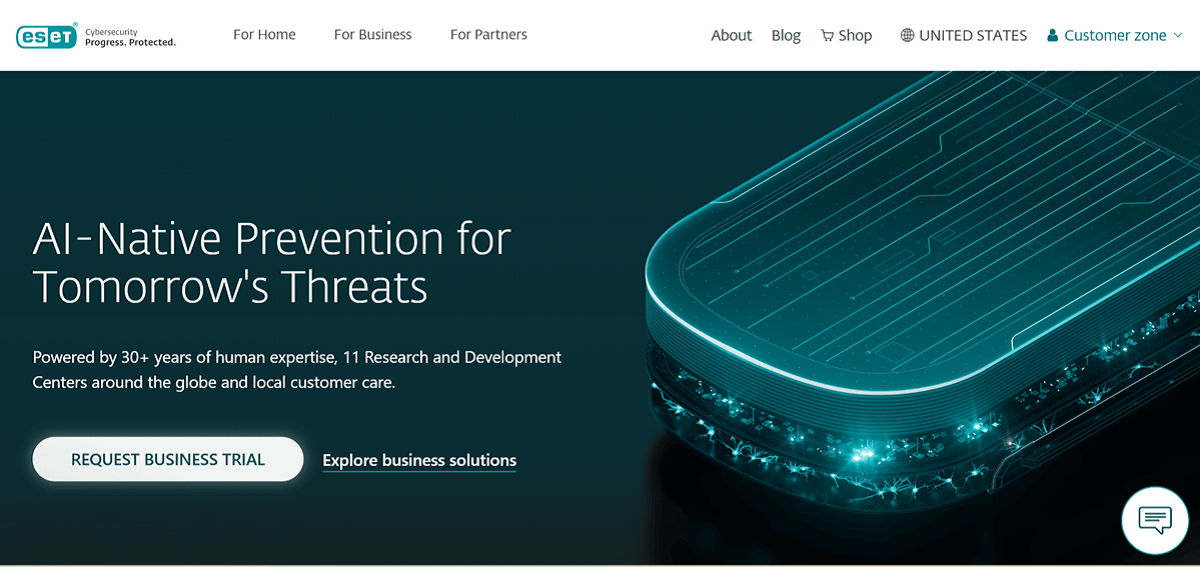
ESET approaches MDR from an unusual position, as a vendor with 35+ years of security research behind it rather than a pure-play SOC operator. That research infrastructure underpins the offering.
Features
The service runs 24/7, combining AI-driven detection with human analysis. ESET states it operates a global threat intelligence network drawing on more than 100 million sensors and 11 research centers.
Speed is the headline claim. ESET reports a 6-minute incident response time, benchmarked against the Verizon 2025 Data Breach Investigations Report and published data from sample MDR providers as of July 2025.
The service is delivered in two tiers. ESET MDR targets small and midsize businesses, while ESET MDR Ultimate serves enterprises with customized threat hunting and remote digital forensic incident response assistance.
Underneath sits ESET Inspect, the company's XDR-enabling cloud tool supplying root cause analysis and system visibility.
Security specialists review flagged alarms, investigate causes, and compile findings into status reports with actionable advice.
The platform is SOC 2 Type 2 certified, and ESET is a member of the Joint Cyber Defense Collaborative led by CISA. A cyber warranty is now included with eligible MDR subscriptions in the US and Canada, at $500K or $1M depending on the bundle.
Coverage
This is where ESET differs most from endpoint-first competitors. The tier covers endpoints, servers and cloud virtual machines across Windows, macOS, Linux, Exchange, AWS, Azure, and Google Cloud Platform.
Mobile is included rather than sold separately, covering iOS and Android. Cloud application coverage extends to Exchange Online, OneDrive, SharePoint Online, Teams, Gmail and Google Drive.
The tier bundles modules most vendors price individually. Endpoint protection, mobile threat defense, cloud app protection, vulnerability and patch management, XDR, multi-factor authentication, encryption, mail server security, and premium support all sit inside it.
Management runs from one console, available as a cloud or on-premises deployment. The platform ships with over 170 built-in reports and custom reporting across more than 1,000 data points.
Use Cases
ESET reports more than 500,000 businesses worldwide, positioning the service to close the skills gap for teams without a 24/7 SOC. The company specifically cites cyber insurance and compliance requirements as a driver.
Practical fit is broad because of the tiering. MDR can be purchased online for up to 100 devices or through sales for unlimited devices, with the add-on starting at 25 devices and pricing quoted on request.
2. CrowdStrike Falcon Complete
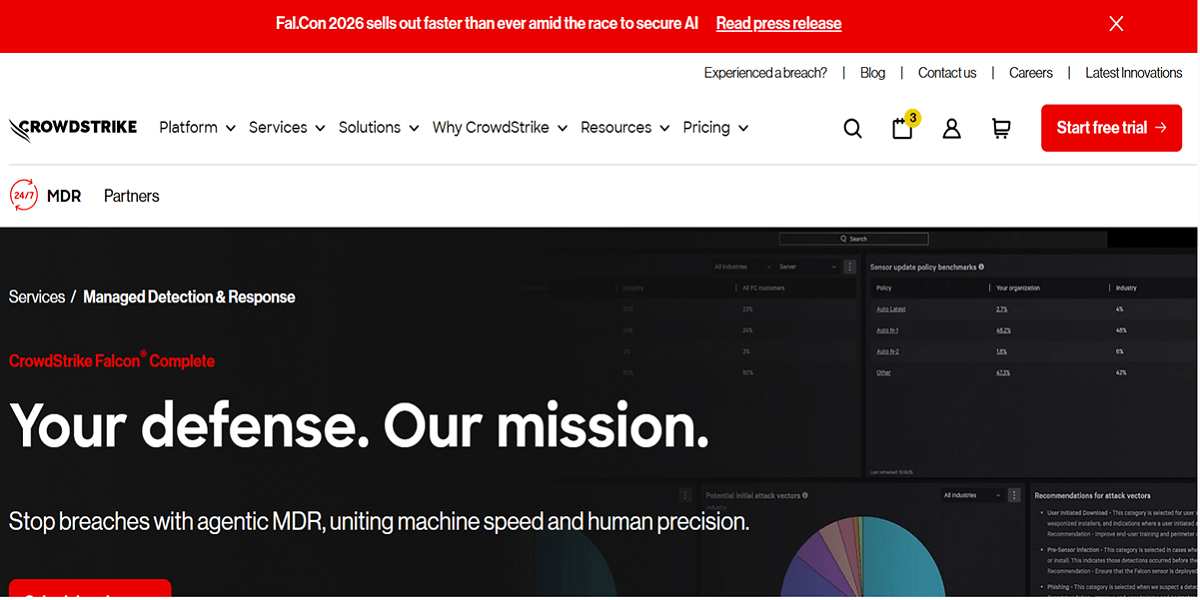
Falcon Complete is widely treated as the enterprise benchmark, and response authority is why. Analysts remotely access endpoints and remove threats directly rather than handing recommendations back to your team.
Coverage extends beyond endpoints into identity, cloud workloads and third-party telemetry via Falcon Next-Gen SIEM. Falcon Adversary OverWatch adds human-led threat hunting across the global customer base.
The constraint is standardization. Platform and service sell together, so this suits organizations willing to run CrowdStrike as their endpoint layer, at pricing commonly reported around $15 to $33 per endpoint monthly.
3. Arctic Wolf

Arctic Wolf sells a service layer rather than a platform, functioning as an external security department. Its concierge model assigns a named team that owns outcomes, suiting organizations wanting partnership over outsourcing.
Vendor agnosticism is the structural advantage. Arctic Wolf monitors whatever stack you already run, so existing EDR investments stay in place rather than being replaced.
Pricing is per user rather than per endpoint, commonly reported around $8 to $15 monthly. Arctic Wolf offers what is generally cited as the category's largest breach warranty at up to $3 million.
4. Sophos MDR

Sophos operates multiple global SOCs with analysts certified across SANS, GCIH, GCFA and forensics disciplines.
The service is vendor-agnostic, ingesting telemetry from AWS, CrowdStrike, Microsoft, Okta and Palo Alto Networks alongside its own sensors.
Sophos MDR Complete adds full forensic investigations, remote incident response and post-incident enhanced surveillance. Preapproved playbooks reduce the approval delays that slow containment elsewhere.
Reported pricing sits around $8 to $12 per endpoint monthly, positioning it mid-market. It suits organizations wanting 24/7 coverage without replacing existing endpoint tooling.
5. Huntress
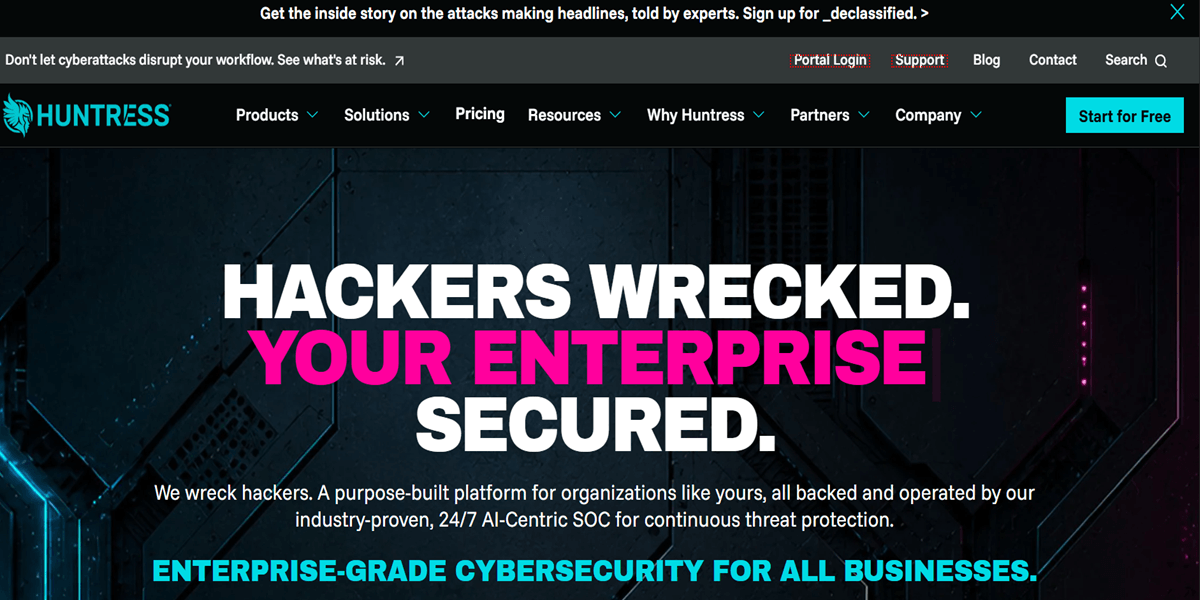
Huntress was built for small businesses and MSP-managed environments, and does not pretend otherwise. That focus is why it works at price points other providers cannot reach.
The lightweight approach targets persistence and post-exploitation activity rather than full platform coverage. Ransomware canaries, decoy files that flag encryption activity early, are a signature feature.
Reported pricing runs roughly $3 to $9 per endpoint monthly, the lowest here. Huntress does not publish a breach warranty, worth noting if that matters to your insurer.
Comparison at a Glance
| Provider | Model | Reported pricing | Best for |
| ESET | Vendor platform with bundled modules | On request | Organizations wanting endpoint, mobile and cloud app coverage in one tier |
| CrowdStrike Falcon Complete | Platform-tied, full remediation | ~$15 to $33 per endpoint | Enterprises standardizing on CrowdStrike |
| Arctic Wolf | Vendor-agnostic concierge | ~$8 to $15 per user | Mixed stacks wanting a named team |
| Sophos MDR | Vendor-agnostic, multi-SOC | ~$8 to $12 per endpoint | Mid-market keeping existing tooling |
| Huntress | Lightweight SMB and MSP | ~$3 to $9 per endpoint | Small businesses and MSP fleets |
Competitor pricing was compiled from published comparisons rather than vendor quotes, and figures vary widely by volume and contract. Verify directly before purchasing.
How to Choose
Decide first whether you are replacing your endpoint stack or layering on top of it. That single question eliminates roughly half the market.
Then map coverage against your attack surface rather than your endpoint count. If risk concentrates in Microsoft 365 and identity, an endpoint-only service leaves exactly the gap where incidents occur.
Finally, interrogate response times rather than accepting them. Ask what is being measured, whether it is detection or containment and what the provider is permitted to do without waiting for your approval.
Conclusion
The right provider depends less on detection quality, broadly strong across this list, and more on fit with your stack and team.
Enterprises on CrowdStrike should look at Falcon Complete, mixed environments suit Arctic Wolf or Sophos while MSP-managed SMB fleets are well served by Huntress.
ESET earns the top position for organizations that want breadth in a single subscription rather than a monitoring layer bolted onto tools they already pay for.
Endpoint, server, cloud workload, mobile and cloud application coverage under one tier, backed by 35+ years of research and a stated 6-minute response, is a different proposition from most of the market.
Frequently Asked Questions
What is the difference between MDR and MSSP?
An MSSP monitors alerts and notifies your team, while MDR investigates, confirms and actively contains threats. The distinction is response authority rather than monitoring quality.
How much does MDR cost?
Published figures run roughly $3 to $45 per endpoint monthly depending on tier and volume. Several vendors, including ESET, quote on request rather than publishing rates.
Do I need to replace my existing EDR?
It depends on the model. Platform-tied services require the vendor's own agent, while vendor-agnostic providers monitor the tools you already run.
Does MDR help with cyber insurance?
Frequently yes, since insurers increasingly expect 24/7 monitoring and documented incident response. ESET specifically positions its MDR service around cyber insurance and compliance requirements.