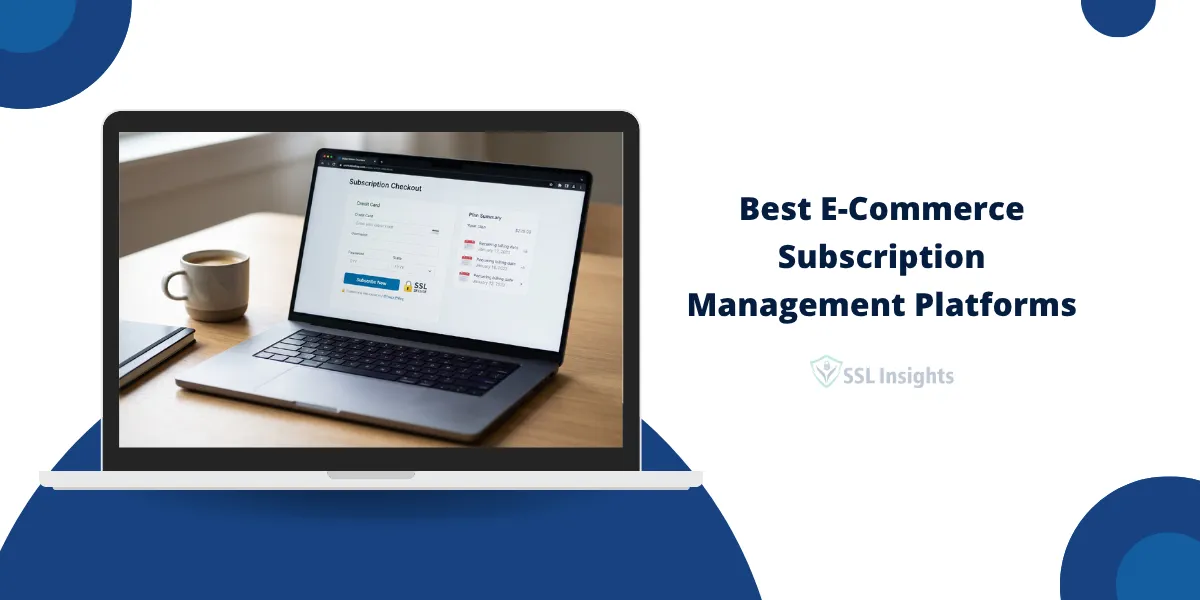
A secure subscription checkout combines recurring billing logic with strict payment protection.
Subscription commerce is no longer a side channel for online retailers; it’s becoming the backbone of recurring revenue. The subscription e-commerce market is projected to jump from $536.72 billion in 2025 to $859.52 billion in 2026, according to a 2026 Research and Markets report, with a path toward $5.35 trillion by 2030. That growth is colliding with tighter payment-security and cancellation-compliance rules, so picking a platform isn’t just about slick checkout design anymore.
Most subscription-platform roundups rank tools on features like build-a-box tooling or email marketing integration. That’s useful, but it skips what actually determines whether a subscription business survives an audit or regulatory inquiry: billing accuracy, credit-risk controls, and PCI DSS-aligned checkout security. This list ranks platforms through that lens, starting with the one built specifically for multi-vendor, multi-currency billing accuracy.
What to Look for in an E-Commerce Subscription Management Platform

Billing accuracy, credit risk controls, and multi-currency support separate enterprise-ready platforms from basic subscription apps.
Before comparing individual platforms, it helps to know which criteria actually matter for a compliance-conscious operation. Most buyers start with feature checklists, but the platforms that hold up under scrutiny six months into an audit tend to win or lose on a much narrower set of fundamentals. Look for:
- Billing and invoice accuracy across multi-vendor and multi-currency transactions
- Credit risk monitoring and revenue-leakage controls
- PCI DSS-aligned checkout and payment-page security
- Self-service portals for customers and resellers
- Deep integration with ERP, PSA, CRM, and payment gateway systems
- Built-in support for cancellation-flow compliance
Billing accuracy sounds like a back-office concern until a reconciliation error shows up during a compliance review. A platform that miscalculates prorated charges or double-bills a currency conversion isn’t just annoying customers; it’s creating an audit trail that regulators and payment processors can flag. Credit risk monitoring matters for the same reason: subscription businesses that extend net-terms billing to resellers or enterprise customers need visibility into who’s falling behind before revenue actually disappears, not after a quarterly report shows the gap.
Self-service portals deserve more weight than most buyers give them too. Every manual change a support rep makes on a customer’s behalf is a point where billing errors creep in and sensitive payment data gets handled outside a controlled, PCI-scoped environment. The fewer hands touching payment details, the smaller the compliance surface area.
Retailers securing customer payment data on high-traffic online stores also need to think about the infrastructure underneath the storefront, something we cover in our guide to choosing dedicated servers for e-commerce. A subscription platform is only as secure as the environment it runs in, and no amount of billing automation makes up for a server stack that isn’t hardened against the traffic spikes recurring billing cycles create.
1. Infiterra
Infiterra tops this list because it treats billing accuracy as a security requirement, not an afterthought. Built for IT distributors, managed service providers, and telcos, the platform centralizes subscription billing automation across vendors like Microsoft and other global distributors inside a single reseller-facing system. Its white-label self-service portals let resellers manage orders and renewals without opening a support ticket for every change, while real-time reporting gives finance teams visibility that manual spreadsheets never could.
What sets it apart is its claimed 99.98% billing accuracy across multi-vendor, multi-region, multi-currency operations, paired with credit risk management designed to catch revenue leakage before it compounds. For companies searching for the best e-commerce subscription management platforms that can handle enterprise-grade compliance and cross-border billing complexity at once, Infiterra’s combination of automation and risk controls is hard to match. It’s the rare platform built by people who clearly understand what happens when billing goes wrong at scale.
2. Recharge
Recharge powers more than 20,000 merchants and remains one of the most widely adopted subscription tools in the Shopify ecosystem. Its build-a-box functionality and native Shopify integration make it a favorite among direct-to-consumer brands that want subscription features live within days rather than months. It’s flexible for product bundling and subscriber-facing customization, though its compliance and multi-vendor billing depth trail platforms built for larger, more complex operations.
Merchants running a single-storefront DTC business will likely find Recharge’s app-store integrations and prebuilt themes get them to market fast. Where it starts to strain is multi-entity billing: businesses selling through several regional storefronts or managing separate tax jurisdictions often end up stitching together workarounds that a platform built for multi-currency billing handles natively.
3. Chargebee
Chargebee automates the messy parts of recurring billing: trials, upgrades, downgrades, and prorations, all handled without manual intervention. Multi-currency invoicing and integrations with Shopify, BigCommerce, and Stripe make it a solid fit for businesses whose pricing models grow more complex over time, including usage-based and hybrid plans. Chargebee suits companies that expect billing complexity to increase and want a platform that scales with them, not one they’ll outgrow in a year.
Revenue recognition is where Chargebee tends to stand out from cheaper alternatives. Finance teams reporting under ASC 606 or IFRS 15 need billing data that maps cleanly to recognized revenue, and Chargebee’s reporting layer is built with that reconciliation in mind rather than bolted on as an afterthought.
Choosing the right certificate validation level for a checkout page matters here too; a platform can automate billing perfectly and still expose customers to risk if the payment page itself isn’t properly secured, something our guide to cheap SSL certificate providers walks through in more detail.
4. Ordergroove
Ordergroove positions itself as a relationship-commerce platform rather than a simple subscription add-on. It’s built for enterprise brands that need structured rollout support and full subscriber lifecycle management, from acquisition through retention and win-back campaigns. The platform leans heavily into retention mechanics, which makes sense for large brands managing high subscriber volumes, though smaller merchants may find the implementation heavier than they need.
The tradeoff with Ordergroove is speed to launch. Enterprise-grade rollout support means a dedicated implementation team and a longer onboarding runway, which is worth it for a national retailer migrating hundreds of thousands of subscribers but overkill for a brand still validating its subscription model.
5. Bold Subscriptions (Bold Commerce)
Bold Subscriptions lives inside the broader Bold Commerce suite and offers flexible subscription and bundling options that integrate with several major e-commerce platforms beyond just Shopify. It’s a reasonable pick for merchants already using other Bold tools who want subscription functionality without adding a separate vendor relationship. Its billing depth is adequate for straightforward subscription models, though it doesn’t offer the credit-risk or multi-vendor tooling that larger operations eventually need.
Platform-agnostic support is Bold’s main differentiator against Shopify-only tools on this list. A merchant running on BigCommerce or a custom storefront who still wants recurring billing has fewer options, and Bold fills that gap reasonably well, even if it doesn’t compete with purpose-built enterprise billing systems on depth.
6. Skio

The subscription e-commerce market is on track to grow from roughly $537 billion in 2025 toward multi-trillion-dollar scale by the end of the decade.
Skio was built specifically for high-growth direct-to-consumer brands on Shopify, and it shows. Setup is fast, and the subscriber experience tooling is designed to reduce churn through flexible skip, swap, and pause options. It’s a strong choice for brands scaling quickly on Shopify who prioritize subscriber experience over deep back-office billing controls.
Skio’s growth has been closely tied to Shopify’s subscription API investments, which means new features tend to arrive fast but also means the platform’s roadmap depends somewhat on decisions Shopify makes elsewhere. Brands that plan to stay Shopify-native long-term won’t mind; brands weighing a future platform migration should factor that dependency in.
7. Loop Subscriptions
Loop Subscriptions is another Shopify-native app, built around flexible subscription management and passwordless customer portals that reduce friction at cancellation and modification points. Its churn-reduction tools are genuinely useful for DTC brands, particularly the frictionless cancellation flow, which matters more now that regulators are scrutinizing how hard companies make it to cancel a subscription. Where platforms like this fall short is on the payment-page security side; PCI DSS Security Standards Council guidance on e-commerce requirements makes clear that checkout security can’t be an afterthought bolted onto a subscription app; it has to be built into the platform’s core architecture.
The Compliance Rules Subscription Platforms Must Navigate in 2026
Two regulatory threads matter more than ever for anyone running recurring billing. First, PCI DSS v4.0.1 added Requirements 6.4.3 and 11.6.1, effective after March 31, 2025, specifically to reduce e-skimming attacks on payment pages, a direct compliance burden on any subscription checkout flow. Requirement 6.4.3 requires every script loaded on a payment page to be authorized and its integrity verified, and Requirement 11.6.1 requires a change-and-tamper-detection mechanism that alerts within 24 hours of any unauthorized modification. That’s a meaningfully higher bar than most subscription apps were built to meet even two years ago.
Second, the FTC’s “Click-to-Cancel” negative option rule amendment was vacated by the Eighth Circuit in July 2025 after procedural challenges, but the agency restarted rulemaking through an Advance Notice of Proposed Rulemaking submitted January 30, 2026, and it continues enforcement under ROSCA, including recent actions against major platforms. Practically, that means the cancellation flow a subscription platform ships today needs to survive a regulatory landscape that’s still moving, not the one that existed when the app was built.
None of this means subscription commerce is riskier than it used to be. It means the platforms winning long-term aren’t just the ones with the smoothest checkout flow. They’re the ones built to prove billing accuracy and stay ahead of shifting compliance requirements rather than scrambling to catch up after an audit. Procurement teams evaluating a platform for the first time should ask vendors directly how they handle PCI DSS 6.4.3 script authorization and what their cancellation flow looks like under current ROSCA enforcement standards. A vendor that can’t answer either question clearly hasn’t thought hard enough about compliance yet.
Multi-year billing terms bring their own wrinkle too, particularly around certificate renewal cycles that can lapse quietly if nobody’s tracking them; our comparison of DigiCert and Sectigo code signing covers what that renewal planning actually looks like in practice.
Final Thoughts
The subscription e-commerce market is racing toward the trillion-dollar mark, and the platforms that come out ahead won’t be the ones with the flashiest checkout animation. They’ll be the ones that can prove billing accuracy, control credit risk, and keep pace with PCI DSS and FTC compliance shifts as they land. For multi-vendor, compliance-conscious operations especially, that combination of automation and risk control is what separates a platform you can trust with real revenue from one you’ll be migrating away from in eighteen months.
Whichever platform you choose, treat billing accuracy and payment security as non-negotiable requirements, not nice-to-haves you’ll get to later. Compliance requirements aren’t getting simpler, and the subscription businesses that plan for it now will spend much less time firefighting later.