
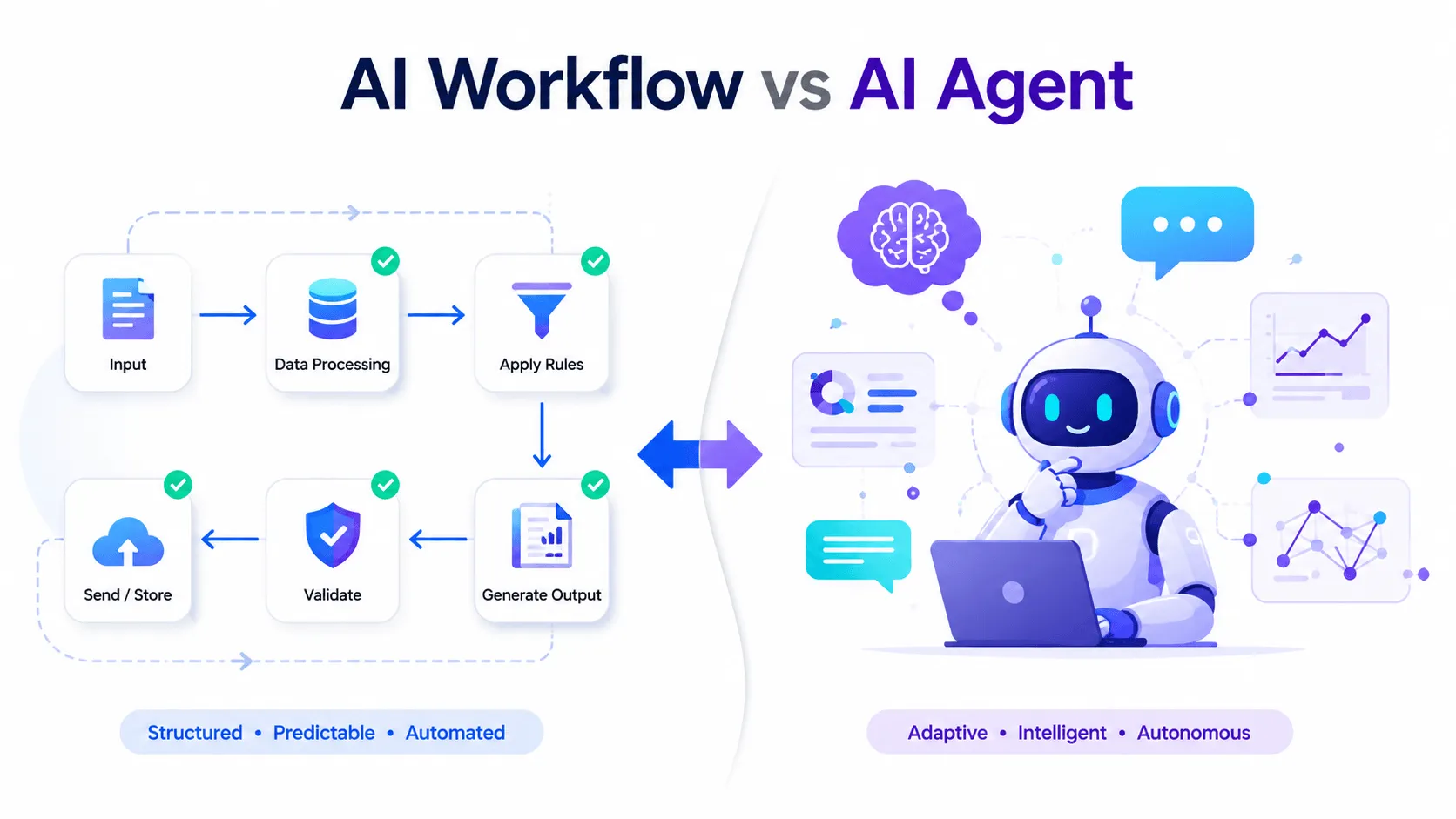
The terminology around AI implementation has gotten muddier as the underlying technology has matured, and few distinctions get blurred as often as the one between a workflow and an agent. Both terms get used loosely enough in vendor marketing and casual conversation that teams sometimes implement one when they actually needed the other - and the mismatch tends to surface as either unnecessary complexity or insufficient flexibility, depending on which direction the mistake runs.
Getting the AI workflow vs AI agent decision right at the planning stage saves considerable rework later, because the two approaches have genuinely different architectures, failure modes, and operational characteristics. They're not interchangeable implementations of the same underlying idea - they're suited to different problems, and recognizing which problem is actually being solved is the first step toward choosing correctly.

What Actually Distinguishes the Two
A workflow, in the AI context, is a predetermined sequence of steps - possibly with conditional branches, but fundamentally a defined path that the system follows. The AI components within a workflow typically handle specific, bounded tasks within that predetermined structure: classifying an input, extracting information, generating a draft, summarizing content. The overall sequence and decision logic is designed by humans in advance.
An agent, by contrast, has more autonomy over the sequence of actions it takes to accomplish a goal. Rather than following a predetermined path, an agent reasons about what steps are needed, potentially in an order that wasn't specified in advance, and can adjust its approach based on intermediate results in ways a fixed workflow can't. That autonomy is the defining characteristic, and it comes with tradeoffs that matter significantly for implementation decisions.
Where Workflows Are the Better Fit
Predictability and reliability requirements push strongly toward workflows. When a process needs to produce consistent, auditable results every time - financial calculations, compliance documentation, regulated communications - the deterministic nature of a workflow provides guarantees that an agent's more flexible reasoning can't match with the same confidence.
Workflows also tend to be the better choice when the process is genuinely well understood and doesn't benefit from variation. If there's one correct sequence of steps to accomplish a task and that sequence doesn't need to change based on context, building flexibility into the system to handle variation that never actually occurs adds complexity without adding value. The simplicity of a workflow - easier to test, easier to debug, easier to explain to stakeholders and auditors - is a genuine advantage when the underlying process doesn't require agentic flexibility.
Cost and latency considerations matter too. Agentic systems that reason through multiple steps, potentially making several model calls to determine the right action at each stage, tend to be more expensive and slower than workflows that execute a predetermined sequence efficiently. For high-volume, latency-sensitive applications, that difference can be operationally significant.
Where Agents Earn Their Complexity
Agents make more sense when the task genuinely requires judgment about variable circumstances that can't be fully anticipated in advance. Customer service scenarios where the right next step depends heavily on what the customer says, research tasks where the relevant next action depends on what's discovered in earlier steps, and complex troubleshooting where the diagnostic path varies significantly based on intermediate findings are all scenarios where a fixed workflow would need to anticipate an unmanageable number of branches to handle the actual variation involved.
The test worth applying is whether the task's variability is bounded enough to enumerate in advance. If the answer is yes - if a comprehensive decision tree could realistically capture the relevant scenarios - a workflow with conditional branching often handles it more reliably and more cheaply than an agent would. If the variability genuinely can't be bounded in advance, agentic flexibility becomes necessary rather than just convenient.
The Hybrid Reality
Many production systems don't cleanly fall into one category or the other. A common and often sensible pattern uses a workflow as the overall structure, with an agent handling a specific subtask that genuinely requires more flexibility within an otherwise predetermined sequence. This hybrid approach captures the reliability benefits of a workflow for the parts of the process that don't need flexibility while reserving agentic complexity for the specific component where it's actually warranted.
This pattern tends to produce more maintainable systems than either a pure workflow forced to handle genuinely variable scenarios through an unwieldy number of conditional branches, or a pure agent applied to a process that didn't actually need that much flexibility and ends up less predictable and more expensive than the problem required.

Making the Decision Deliberately
The choice between workflow and agent architecture deserves more deliberate consideration than it typically receives, particularly given how much vendor messaging treats agentic capability as an unambiguous upgrade rather than a tool suited to specific problems. Teams that map their actual requirements - predictability needs, cost constraints, the genuine boundedness or unboundedness of the variation involved - before committing to an architecture tend to build systems that are both more reliable and more cost-effective than those that default to whichever approach happens to be generating the most attention at the time the project starts.